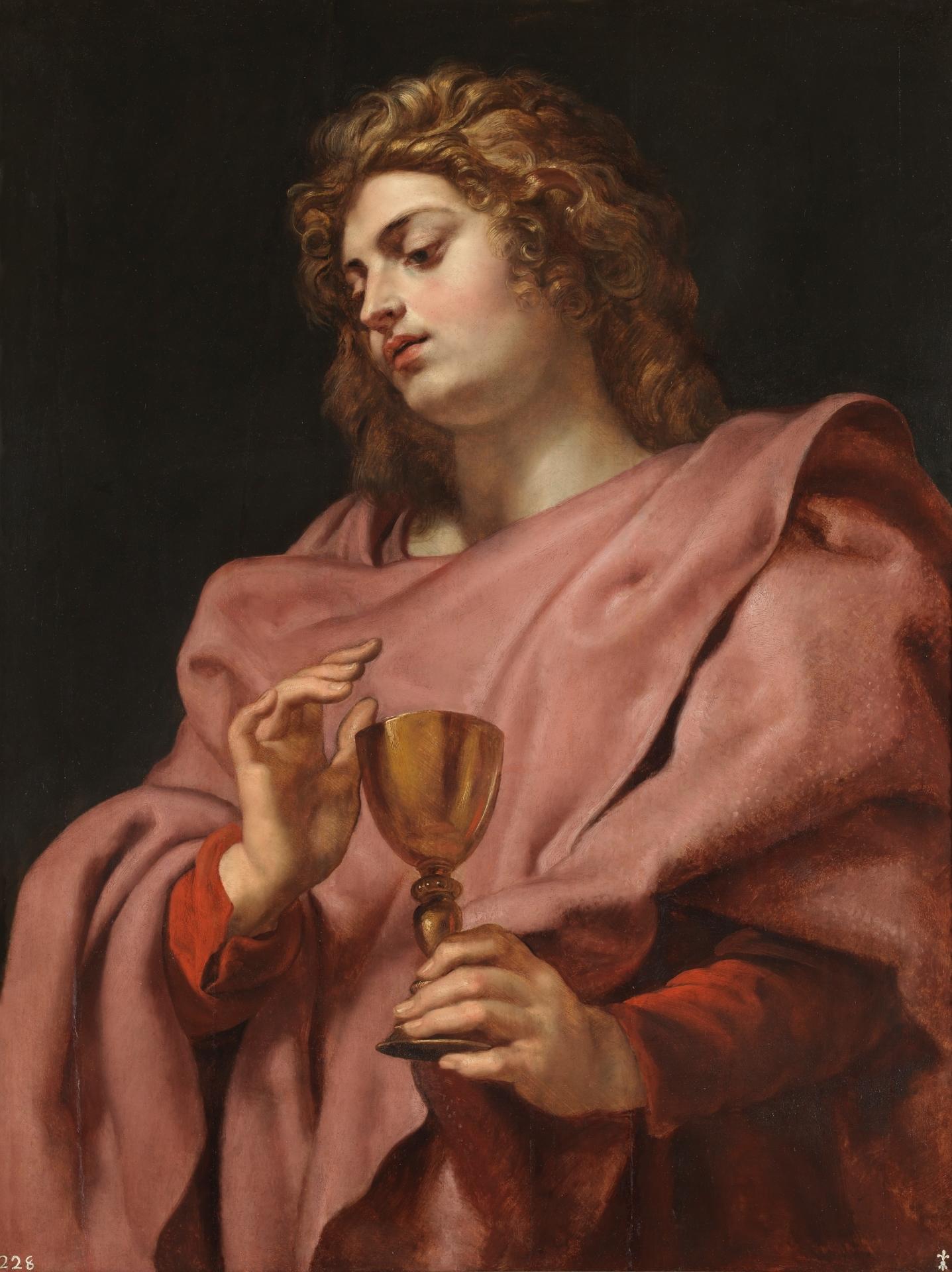
John, son of Zebedee, was the younger brother of James the Greater. He was a fisherman called from the same boat as his brother (Matthew 4:21–22). With Peter and James, he formed the inner three of the apostolic company — present at the Transfiguration, the raising of Jairus's daughter, and Gethsemane. He is uniquely identified in the Fourth Gospel as 'the disciple whom Jesus loved' (John 13:23; 19:26; 20:2; 21:7, 20), a title which the early Church understood as John's self-designation as the Gospel's author.
He reclined next to Jesus at the Last Supper (John 13:23). He stood at the foot of the cross with Mary, the mother of Jesus, and received the charge from the dying Christ to take her into his own home (John 19:26–27). He ran with Peter to the empty tomb on Easter morning, outran Peter, but allowed Peter to enter first (John 20:1–10). After the resurrection he was on the boat with the other disciples at the Sea of Tiberias when Jesus appeared on the shore, and it was John who first recognized him: 'It is the Lord' (John 21:7).
Acts records him in Jerusalem with Peter through the early years of the Church — at the temple gate Beautiful (Acts 3), before the Sanhedrin (Acts 4), and in the mission to Samaria (Acts 8). Paul, writing to the Galatians around 49 AD, names him as one of the three 'pillars' of the Jerusalem church alongside Peter and James the brother of the Lord (Galatians 2:9). Beyond this, the New Testament's direct testimony fades. The post-apostolic tradition, especially the witness of Irenaeus of Lyon (writing c. 180 AD), places John in Ephesus in his later years, where he wrote the Fourth Gospel, the three letters that bear his name, and ultimately the Apocalypse during a period of exile on the island of Patmos under either Nero or Domitian (Revelation 1:9).
Irenaeus is the most important historical link. He had been a disciple of Polycarp of Smyrna, who had been a disciple of John himself. Irenaeus's testimony — that John lived to extreme old age in Ephesus, that he had been the bishop of that church, and that he had personally instructed the next generation including Polycarp — is the closest the Christian historical tradition has to direct apostolic memory. John is the only one of the Twelve who is consistently said in tradition to have died a natural death rather than as a martyr. The legend that an attempt was made to kill him in boiling oil and that he survived unharmed (recorded by Tertullian, De Praescriptione Haereticorum 36) is sometimes cited as evidence of a 'martyrdom without death.'
The five New Testament books traditionally attributed to him — the Gospel, the three letters, and the Apocalypse — together account for about 20% of the New Testament by volume. Modern critical scholarship disputes the unified authorship of all five, with the most widely accepted reconstruction being that 'the Johannine community' — a school of disciples around John in Ephesus — produced the Gospel, letters, and possibly Revelation under his direct apostolic authority and editorial oversight. Whatever the exact authorial circumstances, the early Church's reception treats all five as Johannine and reads them together as a single theological vision: the eternal Word made flesh, the love that defines the divine being, and the apocalyptic vindication of the Lamb that was slain.
Iconographically, John is associated with the eagle — one of the four living creatures of Ezekiel and Revelation, which the early Fathers (following Irenaeus, Adversus Haereses III.11.8) identified with the four Evangelists. The eagle is John because his Gospel soars highest into the contemplation of the divine — 'In the beginning was the Word, and the Word was with God, and the Word was God.' The other attribute is the chalice with a serpent emerging from it, a reference to a medieval legend in which John was given a poisoned cup at Ephesus and the poison left in the form of a snake when he blessed it.