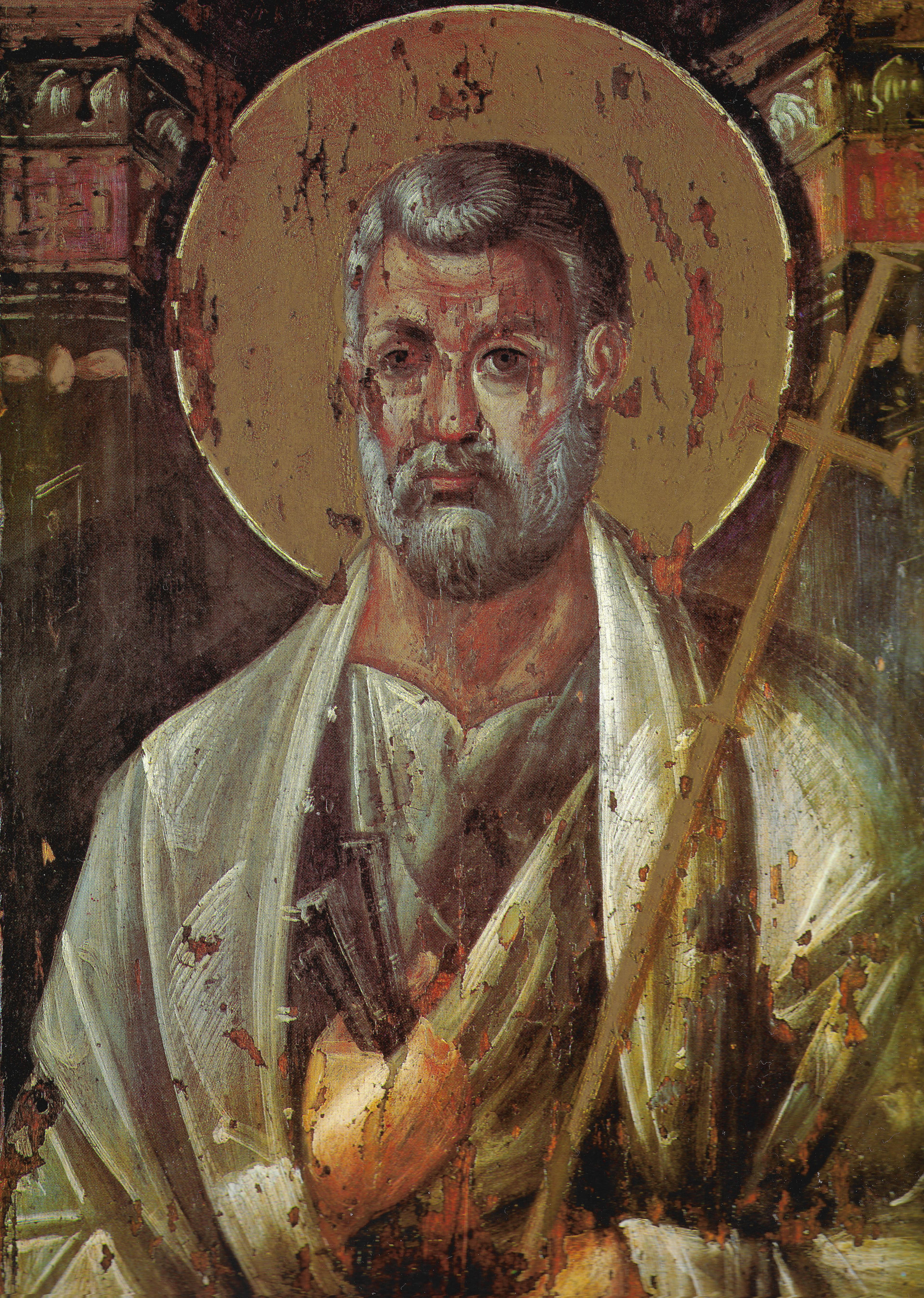
Simon, son of Jonah, was a fisherman from Bethsaida on the northern shore of the Sea of Galilee who worked the lake out of Capernaum with his brother Andrew (Matthew 4:18; John 1:44). His Aramaic nickname, given by Jesus, was Cephas — 'rock' — translated into Greek as Petros (Mark 3:16; John 1:42). The name occurs 156 times in the New Testament, more than any other apostle's. He is consistently the spokesman of the Twelve, the first to confess Christ's identity, the first to deny him, and the first to be restored.
His confession at Caesarea Philippi (Matthew 16:13–20) is the theological hinge of the Synoptic narrative: 'You are the Christ, the Son of the living God.' Jesus's reply — 'You are Peter, and on this rock I will build my church' — has been the most-disputed passage in Christian history regarding ecclesiastical authority. The Roman Catholic tradition reads the 'rock' as Peter himself and locates the papal office in this verse; the Orthodox tradition reads the rock as the confession itself, with Peter participating as its first speaker; the Protestant tradition reads the rock as Christ confessed in the confession. The Greek wordplay between Petros (the masculine noun, Peter's name) and petra (the feminine noun, 'rock') has been read every way the underlying grammar permits.
Peter's denial of Christ (Mark 14:66–72, parallels in all four Gospels) and his restoration by the risen Christ (John 21:15–19) form one of the most psychologically penetrating sequences in the New Testament. The threefold denial is answered by Jesus's threefold 'Do you love me?' — and Peter's three affirmations are followed by three commissions: 'Feed my lambs. Tend my sheep. Feed my sheep.' The pastoral office of the Church is grounded in this passage as much as in Matthew 16.
Acts 1–15 records Peter's leadership of the apostolic Church in its earliest decade. He delivers the sermon at Pentecost (Acts 2), works the first healings (Acts 3), is interrogated by the Sanhedrin (Acts 4), opens the Gentile mission with Cornelius (Acts 10), and presides at the Jerusalem Council (Acts 15). Paul records meeting him in Jerusalem (Galatians 1:18) and confronting him at Antioch over table fellowship (Galatians 2:11–14).
Two New Testament letters bear his name: 1 Peter (almost universally accepted as authentic apostolic writing) and 2 Peter (more disputed in modern scholarship but accepted as canonical from the late second century onward). His martyrdom in Rome is attested by 1 Clement (c. 96 AD), Ignatius of Antioch (c. 108 AD), and Tertullian, and is reasonably well-historically established for the Neronian persecution following the great fire of 64 AD. The tradition that he was crucified inverted (because he asked not to die in the same posture as his Lord) is preserved by Origen but does not appear in the earliest sources. His tomb is identified beneath the high altar of St. Peter's Basilica on the Vatican Hill — an identification supported by 1939–1960s archaeological work that found a first-century burial niche directly under the altar.