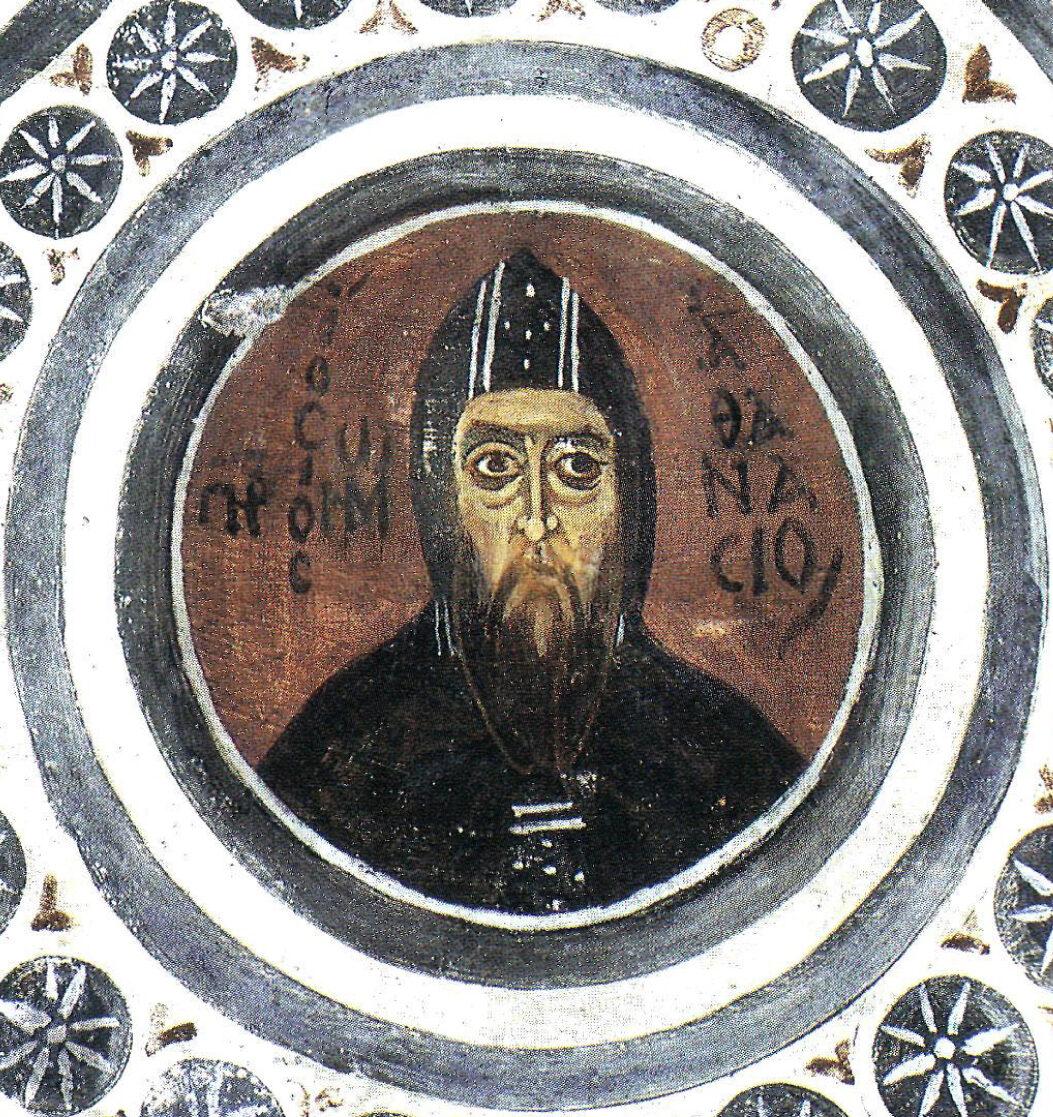
Athanasius of Alexandria
The great defender of Nicene orthodoxy who was exiled five times for refusing to compromise the full divinity of Christ.
“God became man so that man might become God.”
— On the Incarnation
Athanasius of Alexandria stands as one of the most consequential figures in Christian history — the man who almost single-handedly preserved Nicene orthodoxy against the tidal wave of Arianism that threatened to reduce Christ to a created being.
Born around 296 in Alexandria, Egypt, Athanasius served as a deacon and theological secretary to Bishop Alexander, attending the Council of Nicaea in 325 as a young man. When Alexander died in 328, Athanasius became Bishop of Alexandria — a post he would hold, through exile after exile, for 45 years.
The Arian controversy was not merely academic. If Christ was not fully divine — homoousios (of the same substance) with the Father — then salvation itself was at stake. A created mediator cannot bridge the infinite gap between God and creation. Athanasius understood this with total clarity, and it made him immovable.
He was exiled five times by four different Roman emperors, spending 17 of his 45 episcopal years in exile. The phrase Athanasius contra mundum — 'Athanasius against the world' — became his epitaph. He returned each time. Arianism eventually collapsed. The faith he defended became the Creed of the Church.
- Full divinity of the Son — homoousios with the Father
- Salvation requires a truly divine Savior
- The Incarnation as the re-creation of humanity
- Defense of the Nicene Creed against Arianism
Born in Alexandria, Egypt
Attends Council of Nicaea as deacon
Becomes Bishop of Alexandria
First exile — to Trier by Constantine
Returns to Alexandria
Third exile — flees into the Egyptian desert
Final return to Alexandria
Dies in Alexandria after 45 years as bishop
His masterwork on the theology of the Incarnation — why God became man, and what the Word's assumption of flesh accomplishes for all of creation.
Four major orations systematically dismantling Arian theology and defending the eternal, uncreated divinity of the Son.
A biography of the desert father Anthony the Great that became the founding document of Christian monasticism in the West.
Annual pastoral letters to the Egyptian churches, including the 367 letter which is the earliest known list of the 27 New Testament books.