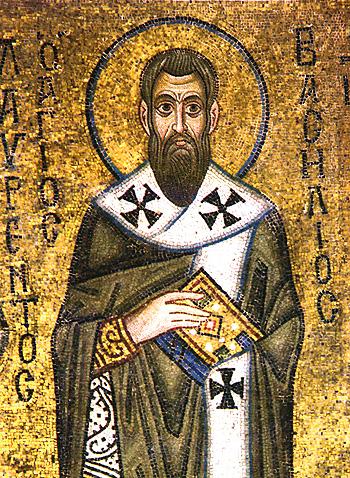
Basil the Great
The Cappadocian theologian who formalized the doctrine of the Trinity, founded the first great hospital in history, and shaped Eastern Christian monasticism.
“The bread you store up belongs to the hungry; the cloak that lies in your chest belongs to the naked.”
— Homily on Luke 12
Basil of Caesarea — called 'the Great' in both East and West — was the architect of post-Nicene Trinitarian theology, the founder of communal Eastern monasticism, and a bishop of extraordinary pastoral vision.
Born in 330 to a remarkable Christian family in Cappadocia, Basil studied at the great schools of Caesarea, Constantinople, and Athens, where he formed a lifelong friendship with Gregory of Nazianzus. Returning to Cappadocia, he renounced his academic career and embraced ascetic life.
As Bishop of Caesarea from 370, Basil governed one of the most important sees in the East during the last intense phase of the Arian controversy. He developed the vocabulary for speaking about the Trinity — three hypostases (persons), one ousia (essence) — that became the settled language of Nicene Christianity.
He also founded the Basiliad — a vast complex outside Caesarea that functioned as a hospital, poorhouse, and hospice, feeding thousands during famines. It is often called the first hospital in history. His monastic rules (the Asketikon) remain the foundation of Eastern Orthodox monasticism to this day.
- Three hypostases, one ousia — the language of the Trinity
- Full divinity of the Holy Spirit
- Communal monasticism as the fullest form of Christian life
- The Church's obligation to the poor as a matter of justice
Born in Caesarea, Cappadocia
Studies in Athens; meets Gregory of Nazianzus
Visits monastic communities in Egypt and Syria
Founds monastic community on family estate
Becomes Bishop of Caesarea
Founds the Basiliad — hospital and social welfare complex
Dies on January 1 in Caesarea
A systematic refutation of the radical Arian theology of Eunomius, defending the full divinity of the Son.
The foundational treatise on the full divinity and personhood of the Holy Spirit, crucial to the expansion of Nicene theology.
Basil's monastic rules for communal life — the foundation of Eastern Orthodox monasticism.
Nine homilies on the six days of creation, integrating natural science and theology.