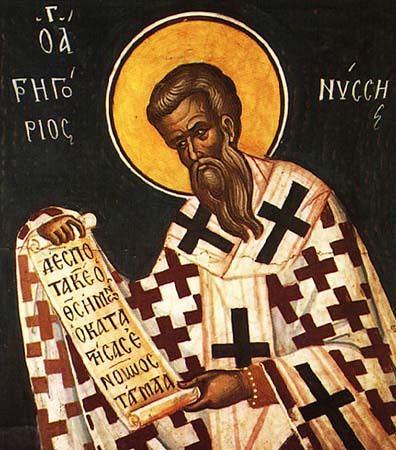
Gregory of Nyssa
The most philosophically profound of the Cappadocians, who developed the theology of infinite divine darkness and the soul's endless ascent into God.
“The soul that looks up toward God and conceives that good desire for His beauty, constantly experiences an ever new yearning for that which lies ahead.”
— Life of Moses
Gregory of Nyssa was the younger brother of Basil the Great and the most philosophically adventurous of the Cappadocian Fathers. While Basil shaped the Church's institutional and liturgical life, Gregory explored the interior depths of theology — the nature of the soul, the infinity of God, and the mystical ascent.
Unlike his brother and Gregory of Nazianzus, Gregory of Nyssa was not shaped primarily by the great schools. He was largely self-taught in philosophy, but his engagement with Platonism produced some of the most original theological thinking of the patristic era.
His Life of Moses became the paradigmatic text of Christian mysticism — Moses's ascent into the divine darkness on Sinai becoming the model for the soul's endless movement into the infinite God. Gregory's key insight was that God's infinity means the soul never reaches a final resting place but goes from glory to glory forever.
After Basil's death in 379, Gregory became the primary defender of Nicene theology at the Council of Constantinople in 381, and one of the most prolific writers of the patristic age.
- Divine infinity — God has no bounds, limiting Him would unmake Him
- Epektasis — the soul's eternal progress into an inexhaustible God
- Apophatic theology — God known best by what He is not
- Universal restoration (apokatastasis) — a controversial hope for all creation
Born in Caesarea, Cappadocia
Made Bishop of Nyssa by Basil
Exiled by the Arian emperor Valens
Returns after Valens's death at Adrianople
Plays key role at First Council of Constantinople
Writes Life of Moses and major mystical works
Dies, date uncertain
The foundational text of Christian mysticism — Moses's ascent into divine darkness as the paradigm of the soul's infinite journey into God.
A massive refutation of Eunomian Arianism, defending the incomprehensibility of the divine essence.
A dialogue with his dying sister Macrina on the nature of the soul and the resurrection — modeled on Plato's Phaedo.
15 homilies reading the Song of Songs as the soul's mystical ascent to union with the divine Logos.