Ignatius of Antioch
The Apostolic Father who, chained on his way to martyrdom in Rome, wrote seven letters that defined the theology of the Eucharist, the episcopate, and the unity of the Church.
“I am God's wheat, and I am ground by the teeth of wild beasts that I may be found pure bread of Christ.”
— Letter to the Romans
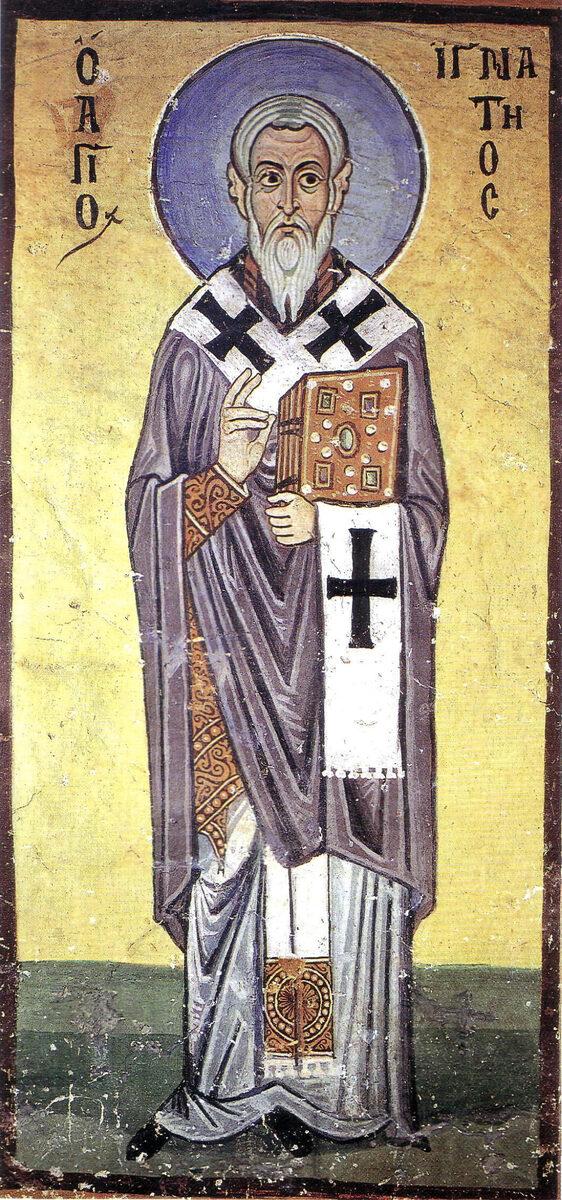
Ignatius of Antioch called himself Theophoros — God-Bearer. He was the second or third Bishop of Antioch after Peter, and a disciple of the Apostle John. Condemned to death by wild beasts in the arena at Rome under Trajan, he wrote seven extraordinary letters en route to his martyrdom.
These letters — to the churches of Ephesus, Magnesia, Tralles, Rome, Philadelphia, Smyrna, and to Polycarp — are among the most theologically rich documents outside the New Testament. They were written in chains, under guard, between 107 and 108 AD.
Ignatius was the first Christian writer to use the word 'catholic' (katholikos) to describe the Church: 'Where the bishop is, there is the catholic Church.' He was also among the earliest and most explicit defenders of the full humanity and divinity of Christ against the Docetists, who claimed Christ only appeared to suffer.
His letter to the Romans, begging them not to interfere with his martyrdom, is one of the most startling spiritual documents in history: 'I am God's wheat, and I am ground by the teeth of wild beasts that I may be found pure bread of Christ.'
- The Eucharist as the 'medicine of immortality'
- Episcopal unity as the sign of the Church's catholicity
- Full humanity and divinity of Christ against Docetism
- Martyrdom as the fullest imitation of Christ
Born in Syria, possibly Antioch
Becomes Bishop of Antioch
Arrested under Emperor Trajan; sent to Rome
Writes seven letters during the journey to Rome
Martyred in the Colosseum, Rome
Letters to Ephesus, Magnesia, Tralles, Rome, Philadelphia, Smyrna, and Polycarp — foundational texts for ecclesiology, Eucharist theology, and Christology.