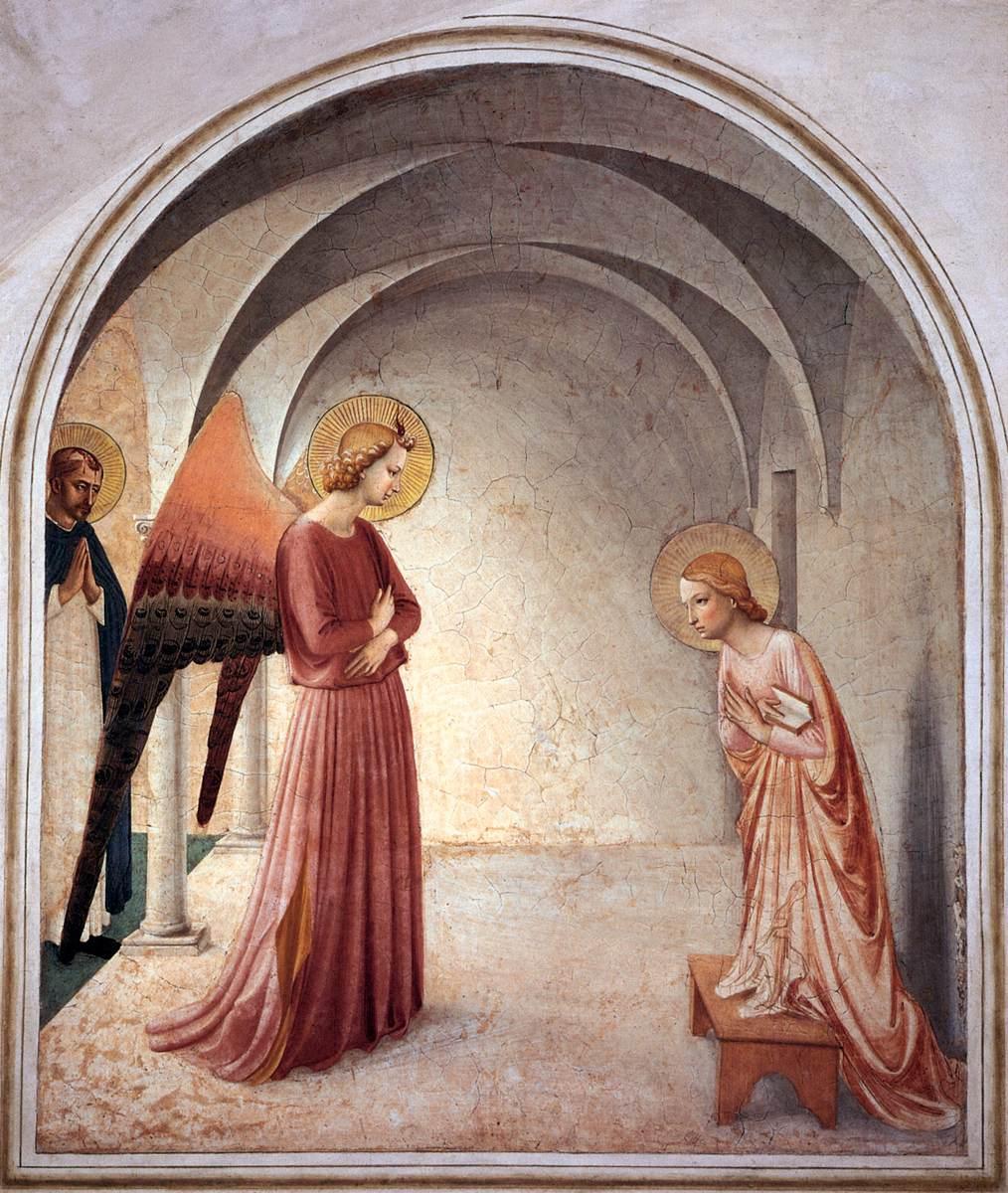
Gabriel — Hebrew Gavri'el, 'Mighty One of God' or 'Man of God' — is named four times in canonical Scripture, twice in Daniel and twice in Luke. He is consistently a messenger of revelation, and the symmetry between the Daniel and Luke appearances is theologically central to the Christian reception of his role.
In Daniel 8:16 he is sent to interpret the apocalyptic vision of the ram and the goat — the figure of a fierce king to come, generally read as a typological reference to Antiochus IV Epiphanes. In Daniel 9:21–27 he delivers the prophecy of the seventy weeks, the longest single chronological prediction in the Hebrew Bible and a passage whose interpretation has occupied Jewish and Christian commentators for two and a half millennia. The prophecy locates the coming of an Anointed One within a precise span of years, and traditional Christian exegesis — from Tertullian and Africanus through Augustine and into modern study — has consistently read it as foretelling the arrival of the Messiah.
In Luke 1:11–20 Gabriel appears to Zechariah in the temple, identifying himself with formal solemnity: 'I am Gabriel, who stands in the presence of God; I have been sent to speak to you and to bring you this good news.' The phrase 'who stands in the presence of God' — Greek parestēkōs enōpion tou theou — places him in the inner circle of the divine throne room. In Luke 1:26 he is sent to a virgin named Mary in Nazareth with the most consequential announcement in human history. Gabriel speaks four times in Luke; each utterance is preserved.
The connection between the four appearances is theological. Gabriel announces the timing of the Messiah in Daniel's seventy weeks, then arrives himself to announce the Messiah's birth six centuries later — the same messenger from prophecy to fulfillment. He is the angelic counterpart to the prophets: not the agent of God's judgment but the bearer of his speech.
Unlike Michael, Gabriel is never described as a warrior in canonical Scripture. His vocation is the word. The Annunciation became one of the most-depicted scenes in the entire history of Western art: from the early Christian frescoes of the catacombs through Fra Angelico's serene Florentine versions (c. 1430–45) to the radical Caravaggesque treatments of the seventeenth century. The icon-tradition of the Orthodox East gives Gabriel a particular distinctive: he is shown with a staff or lily in his left hand and a triumphant raised right hand, gesturing toward Mary in a posture of greeting that is simultaneously deferential and decisive.
1 Enoch lists Gabriel as the fourth of the Archangels who stand before the Lord (chapter 40), with the specific portfolio of 'all the powerful'. Later Jewish apocalyptic and rabbinic tradition expanded his role substantially: as the angel who destroyed Sodom (some haggadic readings), as the angel who wrestled with Jacob (alternative to Michael), and as the angel who blew the trumpet to announce the giving of the Law at Sinai. Christian liturgical tradition has held this expanded mythology at arm's length, preferring the canonical core: Gabriel is the messenger of the Incarnation and that is enough.