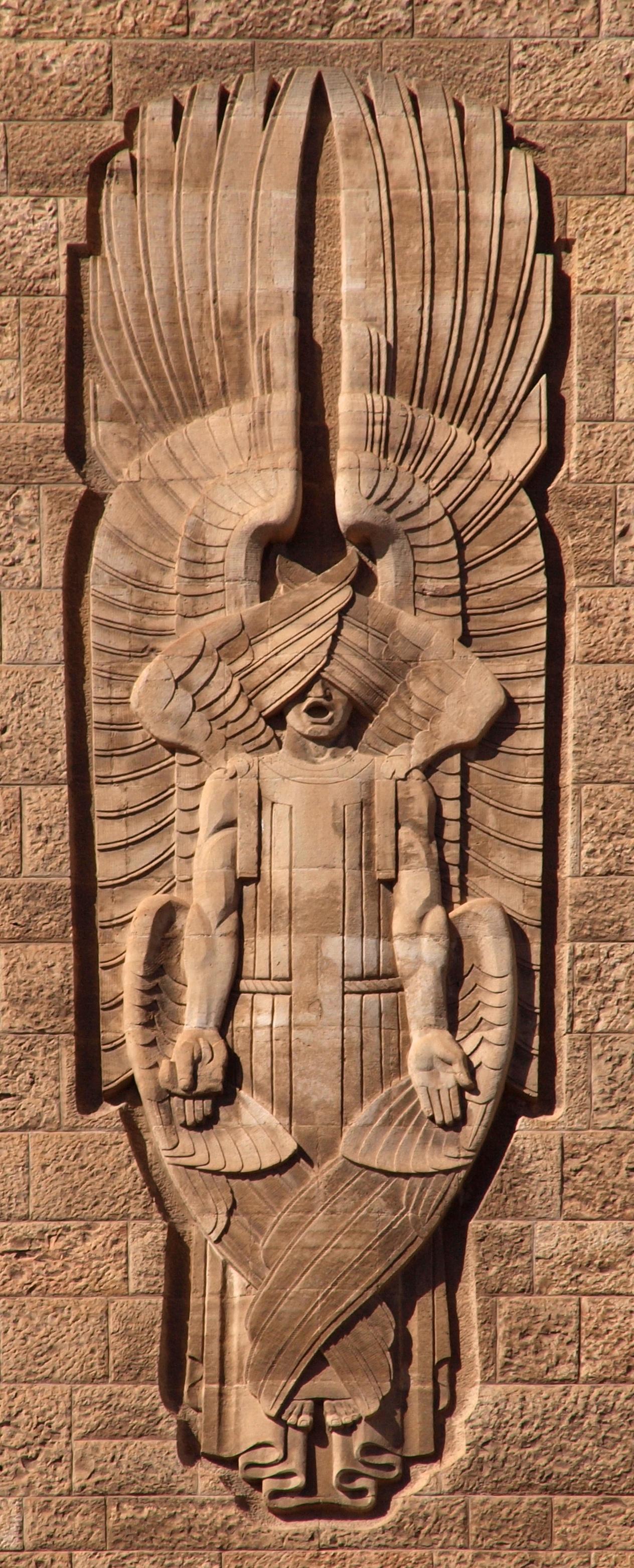
The Seraphim — Hebrew śerāphîm, plural of śaraph, 'burning one' — appear only once in canonical Scripture by that name, in Isaiah 6:1–7. The vision is one of the most theologically dense passages in the entire prophetic corpus. Isaiah, in the temple in 'the year that king Uzziah died' (probably 740 BC), sees 'the Lord sitting upon a throne, high and lifted up, and his train filled the temple.' Above the throne stand the Seraphim, six-winged: 'with twain he covered his face, and with twain he covered his feet, and with twain he did fly.' They cry to one another, 'Holy, Holy, Holy is the LORD of hosts; the whole earth is full of his glory' — the threefold doxology that became the Sanctus of the Christian liturgy and the Trisagion of the Eastern rite.
The Hebrew word śaraph is the same root used elsewhere in the Pentateuch for the 'fiery serpents' that bit the Israelites in the wilderness (Numbers 21:6–9). The bronze serpent that Moses lifted up to heal them is called a śaraph in the same passage. Whether the Seraphim of Isaiah 6 are conceptually related to these 'burning serpents' — perhaps a class of seraph-creatures whose appearance involved both fire and serpentine form — is debated. The ancient Near Eastern background includes winged-serpent throne-guardians in Egyptian iconography (the uraeus) and in Mesopotamian temple art, and some modern scholars have read Isaiah 6 in that visual register. Patristic Christian tradition, however, did not emphasize the serpentine reading, focusing instead on the fire.
Patristic theology made the Seraphim the highest order of the angelic host. Pseudo-Dionysius the Areopagite, in Celestial Hierarchy VII (composed c. 500 AD), places the Seraphim as the first order of the first triad — the angelic beings closest to God, perpetually engaged in the act of worship rather than in mission to creation. 'Their pure name,' he writes, 'manifests their state ever in motion around the Divine, their perpetual fervor and excitement, their ardent, intense, overflowing love.' Their burning is not destruction but love: a perpetual fire of adoration that consumes their attention entirely.
When a seraph touches Isaiah's lips with a burning coal from the altar, his sin is purged. 'Then flew one of the seraphims unto me, having a live coal in his hand, which he had taken with the tongs from off the altar: And he laid it upon my mouth, and said, Lo, this hath touched thy lips; and thine iniquity is taken away, and thy sin purged.' The Eastern Orthodox Divine Liturgy of John Chrysostom incorporates this image at the moment of the priest's preparation for the Eucharist — the coal as the body of Christ, the lips of the worshipper purified by the same fire that purified Isaiah's. This is one of the most direct ways in which patristic angelology shaped enacted Christian worship.
The threefold 'Holy, Holy, Holy' of Isaiah 6:3 is preserved in nearly every historic Christian liturgy. The Latin Sanctus, the Greek Trisagion, the Slavonic Trisvyatoye — all derive from the Seraphim's cry. The same cry returns in Revelation 4:8, where the four living creatures around the throne (themselves a parallel or composite figure with the Cherubim of Ezekiel) chant: 'Holy, holy, holy, Lord God Almighty, which was, and is, and is to come.' The eschatological liturgy and the temple liturgy are framed as the same liturgy at different ages of the world.
Theological reception of the Seraphim has typically emphasized two themes. First, the threefold sanctus has been read across the patristic tradition (Origen, Athanasius, Augustine, Aquinas) as an implicit witness to the Trinity — three repetitions for three persons, addressed to one Lord. Second, the wing arrangement — two covering the face, two covering the feet, two for flight — was read by patristic commentators as a portrayal of the angelic relation to God: even the highest order does not gaze directly at the divine glory but veils itself before it, while remaining always in motion toward and around the throne.