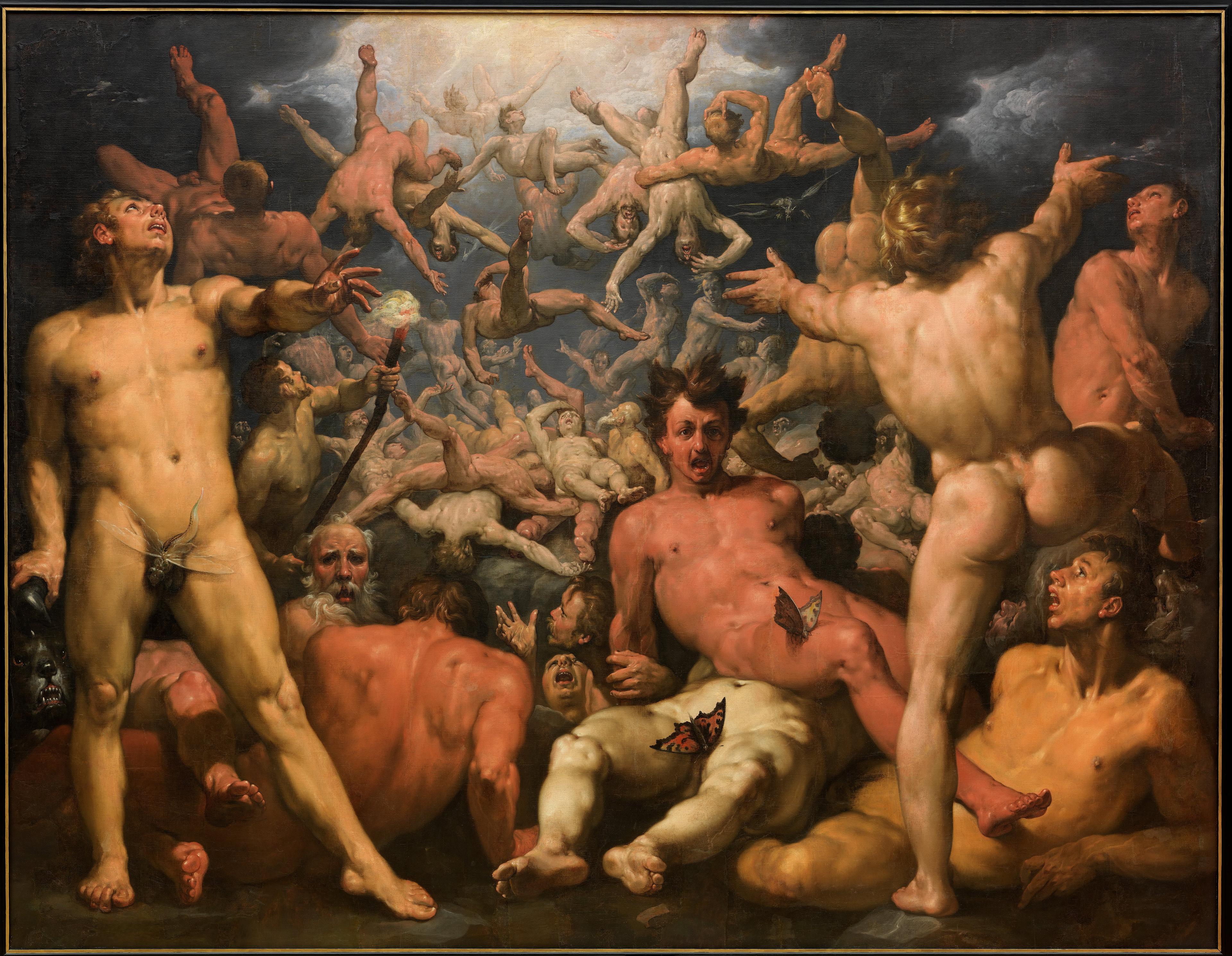
The Nephilim are named in two places in the canonical Hebrew Bible. The first is Genesis 6:4, immediately after the descent of the 'sons of God' to take wives of the daughters of men: 'The Nephilim were in the earth in those days, and also after that, when the sons of God came in unto the daughters of men, and they bare children to them; the same were the mighty men which were of old, the men of renown.' The second is Numbers 13:33, where the Israelite spies returning from the land of Canaan report that they saw the Nephilim — specifically the Anakim — and felt 'like grasshoppers' beside them.
The Hebrew word nephilim derives from the root npl, 'to fall.' Whether this is best translated 'fallen ones' (passive sense, referring to their fall from heaven) or 'those who cause to fall' (active sense, referring to their causing the fall of others through violence) is disputed in modern scholarship, but the early Greek translators of the Septuagint chose gigantes — 'giants' — and the long Christian tradition has read them as both fallen and gigantic.
Second Temple Jewish interpretation, preserved in 1 Enoch 7:1–6 and the Book of Jubilees, expands the canonical sketch into a full cosmological narrative. The Nephilim are the hybrid offspring of the Watchers and human women. They grew to enormous height — '3,000 ells' in some manuscript traditions of 1 Enoch, an obvious literary hyperbole — and consumed all the available food. When that ran out, 'the giants turned against them and devoured mankind. And they began to sin against birds, and beasts, and reptiles, and fish, and to devour one another's flesh, and drink the blood.' The Flood narrative of Genesis 6:5–7, which describes the earth as 'filled with violence,' is in the Second Temple reading directly caused by the Nephilim.
1 Enoch 15:8–16:1 is one of the most theologically significant passages in the entire apocryphal corpus. It explains what happened to the Nephilim when the Flood came: 'And now, the giants, who are produced from the spirits and flesh, shall be called evil spirits upon the earth, and on the earth shall be their dwelling. Evil spirits have proceeded from their bodies; because they are born from men and from the holy Watchers is their beginning and primal origin; they shall be evil spirits on earth, and evil spirits shall they be called.' The Nephilim died bodily in the Flood, but their composite nature — angelic spirit joined to mortal flesh — meant their disembodied spirits could not depart to the proper resting place of the dead. They became, in 1 Enoch's framework, the demons of the post-Flood world.
This is the framework inside which the New Testament's demonology operates. When the Synoptic Gospels describe Jesus casting out 'unclean spirits' or 'demons,' the term being used is precisely the Second Temple word for the disembodied spirits of the Nephilim. The Gerasene demoniac (Mark 5:1–20) speaks of 'Legion' — a host of spirits — and they beg not to be sent 'out of the country,' but rather into the bodies of swine, because (in the Enochian framework) they cannot exist apart from a material host. The legions of demons in the gospels are, on this reading, the survivors of the Flood.
Canonical Scripture preserves traces of the giant-clans across the conquest narrative. The Anakim of Numbers 13 and Joshua 11. The Rephaim of Deuteronomy 2 and 3. The Emim and Zamzummim of Deuteronomy 2:10–11 and 20–21. Og of Bashan, the last of the Rephaim, whose iron bed was thirteen feet long (Deuteronomy 3:11). Goliath of Gath (1 Samuel 17), explicitly identified by his physical stature and place of origin in a land of giants. The biblical pattern is that the giants are a real, persistent threat across the conquest, that they are systematically destroyed, and that their elimination is part of the redemptive narrative of Israel's possession of the land.
The Sethite reinterpretation begun by Augustine in the fourth century read the 'sons of God' as righteous men of Seth's line and the 'daughters of men' as the corrupt women of Cain's, with the Nephilim therefore being merely human heroes of a violent age. This reading dominated medieval and Reformation interpretation, especially in the Latin West. But the Second Temple reading was preserved in Eastern Orthodox biblical commentary, in the Ethiopian Orthodox canon (which retains 1 Enoch as Scripture proper), and in marginal Protestant traditions; it has been substantially recovered in modern critical scholarship over the last forty years.