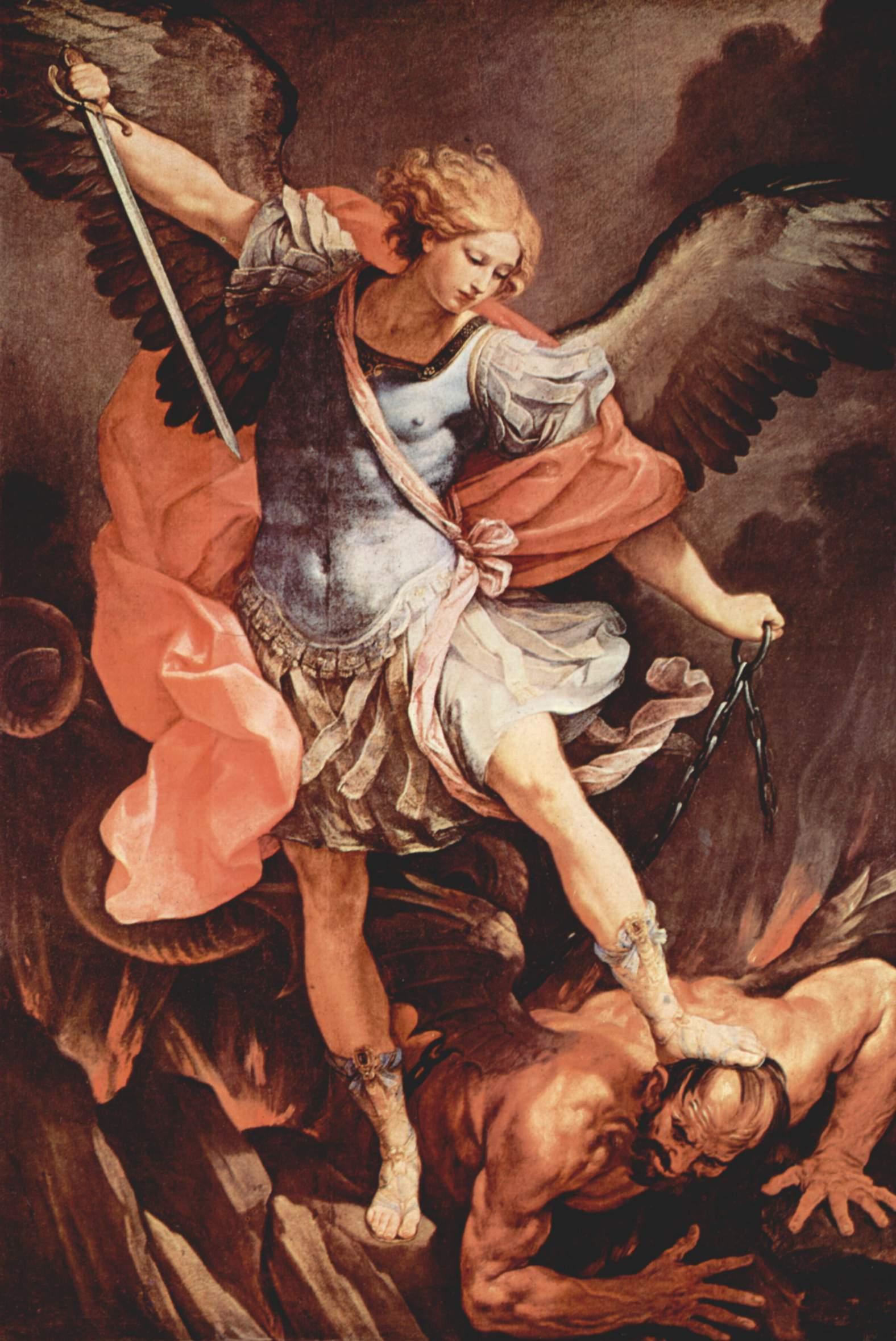
Michael — the Hebrew name means 'Who is like God?' — is the only angel named in both the Old and New Testaments who is explicitly titled an archangel in Scripture (Jude 1:9). His role is consistently military and guardian. In Daniel 10:13 he is identified as one of the 'chief princes' who comes to the aid of Daniel against the prince of Persia, a celestial being who had withstood the prophet's intercession for twenty-one days. In Daniel 12:1 he is named as 'the great prince who stands for the children of Israel,' and his rising will mark the beginning of the eschatological deliverance.
Jude 1:9 records a curious episode — apparently drawn from a now-lost section of the Assumption (or Testament) of Moses — in which Michael disputes with the devil over the body of Moses but refuses to pronounce a railing judgment, leaving it to the Lord. This is not a minor narrative detail. It establishes a foundational pattern: even the chief archangel does not act on his own authority. He defers to the Name. The pattern is repeated in Revelation 12:7–9, where Michael and his angels wage war against the dragon, but the victory itself is attributed to 'the blood of the Lamb' (Revelation 12:11). Michael fights; Christ wins.
Patristic theology elaborated his role in several directions. Pseudo-Dionysius the Areopagite places him among the Archangels — the second-lowest of the nine ranks in the Celestial Hierarchy, the order closest to humanity and most directly engaged in mission to the world. Eastern Orthodox tradition titles him 'Archistrategos' — supreme commander — of the heavenly host. The Coptic tradition gives him a particular liturgical prominence, with the 12th of every Coptic month dedicated to him. In Latin tradition, the Feast of Michaelmas (September 29) commemorates the consecration of the Basilica of St. Michael the Archangel on the Salarian Way in Rome.
Iconographically, Michael is almost universally depicted in armor, with a sword or spear, often standing over the conquered dragon or trampling the figure of Satan beneath his feet. The most famous painting in this tradition is Guido Reni's 1636 'San Michele Arcangelo,' commissioned by the Barberini family for the Cappuccini church in Rome — a work whose iconography would shape Western depictions of Michael for the next four centuries.
The eschatological role of Michael is especially significant. Patristic and medieval theology connected three threads: his role as the angel of Israel (Daniel 12), his role at the heavenly war (Revelation 12), and the voice 'of the archangel' that accompanies Christ's return in 1 Thessalonians 4:16. Many ancient liturgies, both East and West, also invoked Michael as the psychopomp — the angel who guides the souls of the faithful at the hour of death and presents them at the heavenly judgment, an extension of his Danielic role as the prince who stands for God's people.