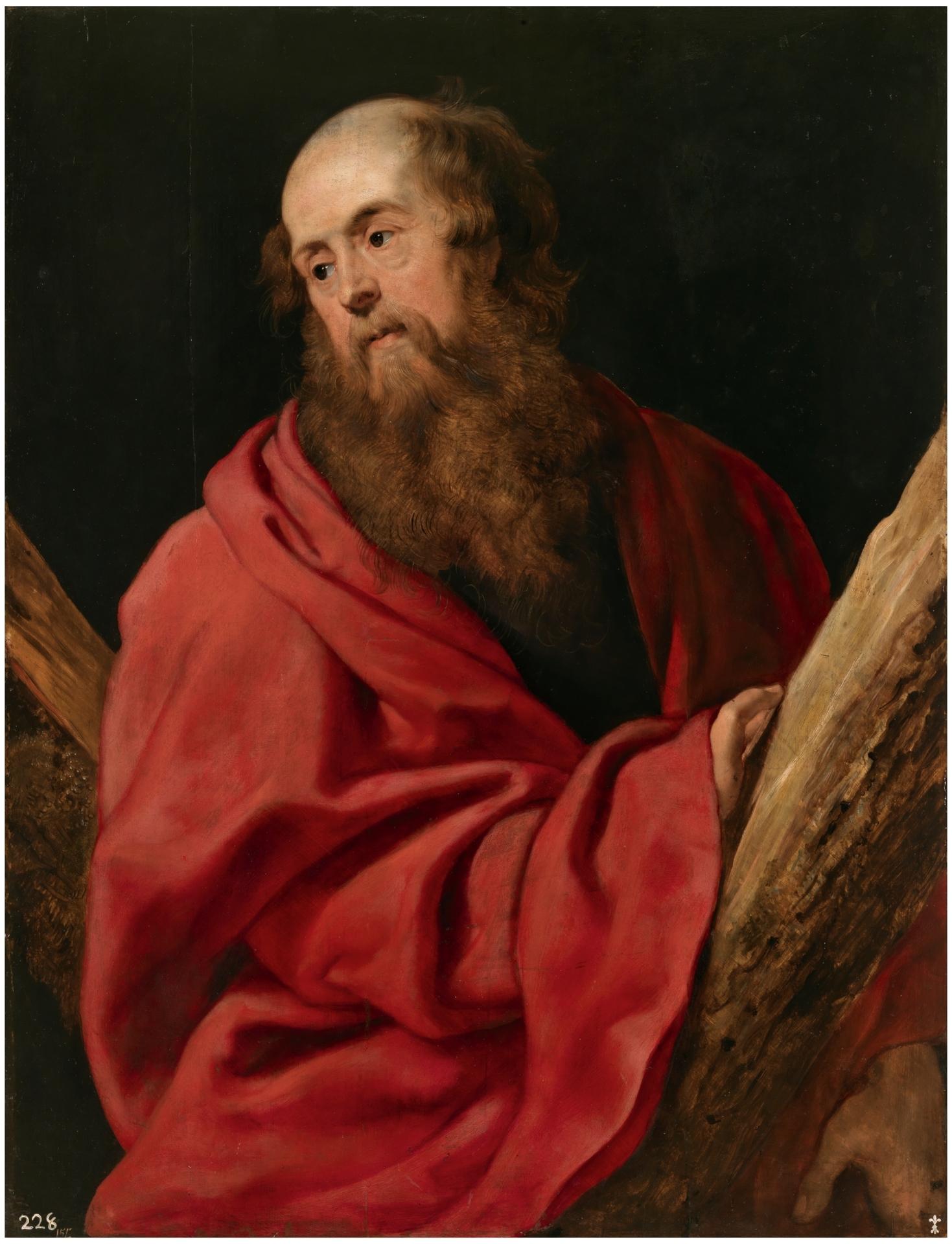
Andrew was a fisherman from Bethsaida and the elder brother of Simon Peter (John 1:40; Matthew 4:18). The Gospel of John records that he was originally a disciple of John the Baptist and was directed to Jesus by his teacher's testimony — 'Behold the Lamb of God' (John 1:36). He followed Jesus, spent the day with him, and immediately found his brother Simon and brought him to Christ with the words 'We have found the Messiah.' This earned Andrew the Eastern title Prōtoklētos — 'the First-Called' — and a particular veneration in the Greek and Slavic Christian traditions that has continued unbroken to the present.
His role in the Gospels is consistently as the brother who brings people to Jesus. In John 6, when the crowd needs to be fed, it is Andrew who notices the boy with five loaves and two fish and brings him to Jesus. In John 12, when Greeks who have come to the Passover ask Philip to take them to Jesus, Philip consults with Andrew, and the two of them bring the request together. The pattern is distinctive: Andrew is the connector, the apostle whose name occurs less often than Peter's or John's but whose function is consistently to widen the circle of those who meet Christ.
Post-resurrection tradition takes Andrew far from Galilee. Eusebius, citing Origen, places his missionary work in Scythia — the lands north and east of the Black Sea, modern Ukraine and southern Russia. The Russian Orthodox Church honors him as its founder for this reason; St. Andrew's Day is the patronal feast of Russia. Later tradition extends his mission through Asia Minor and into Greece, with his martyrdom traditionally located at Patras under the Roman proconsul Aegeates.
The tradition that he was crucified on an X-shaped cross (saltire) rather than a Latin cross is medieval, first attested in the 10th century. The Acts of Andrew, a late-second-century apocryphal text, describes his martyrdom on a cross but does not specify the shape. By the high medieval period the saltire had become so firmly identified with him that the X-cross is now universally called 'St. Andrew's Cross' and appears on the flags of Scotland (where Andrew is also patron), the Russian Navy, and historically on Confederate-era American battle flags. The Scottish association traces to a 13th-century legend that an X-shaped cloud appeared over a Pictish army about to fight Northumbrian Anglo-Saxons; the Picts won, attributed the victory to Andrew, and adopted his cross.