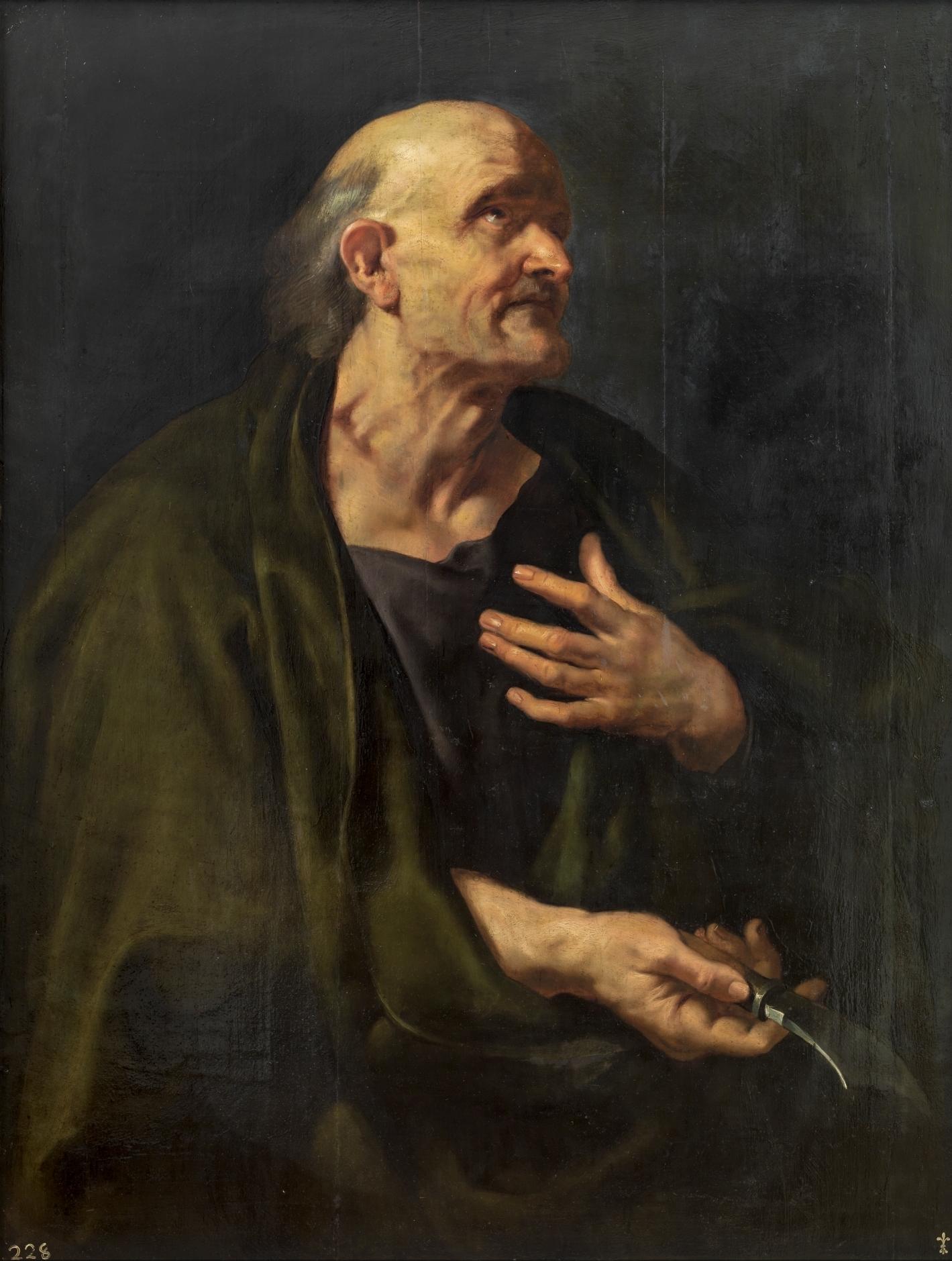
Bartholomew is named in the lists of the Twelve in Matthew 10:3, Mark 3:18, Luke 6:14, and Acts 1:13 — always paired with Philip in the lists. The name 'Bartholomew' is a patronymic (bar-Talmai, 'son of Talmai') and is not a first name. The same apostle is almost certainly the figure named Nathanael in John 1:45–51 and 21:2 — the man Philip brings to Jesus with the announcement, 'We have found him of whom Moses in the law and the prophets did write.' Nathanael's initial skepticism — 'Can any good thing come out of Nazareth?' — is followed by Jesus's striking greeting: 'Behold an Israelite indeed, in whom is no guile.' When Nathanael asks how Jesus knows him, Jesus replies: 'When thou wast under the fig tree, I saw thee.' Nathanael's response is one of the most rapid Christological confessions in any of the Gospels: 'Rabbi, thou art the Son of God; thou art the King of Israel.' The identification of Bartholomew with Nathanael, while not explicitly stated by the texts, is the consensus of the patristic tradition and follows from the pairing with Philip in the Synoptic lists.
The post-apostolic tradition gives Bartholomew an unusually wide mission field. Eusebius records (citing Pantaenus, the late-second-century head of the catechetical school of Alexandria) that Pantaenus, traveling to 'India' in the 180s AD, found Christians there who possessed a Hebrew copy of the Gospel of Matthew which they said Bartholomew had brought to them. The 'India' of the ancient sources is geographically ambiguous and probably refers to the Arabian peninsula or southern Mesopotamia rather than the Indian subcontinent. Other traditions place his mission in Armenia, Mesopotamia, and Lycaonia in Asia Minor.
The martyrdom tradition is unusually grim. Bartholomew is said to have been killed by being flayed alive (skinned) and then beheaded, on the orders of King Astyages of Albanopolis in Armenia, for converting the king's brother Polymius. The story first appears in the apocryphal Martyrdom of Bartholomew (c. 5th–7th century) and is not securely historical, but it has shaped his Western iconography decisively. Michelangelo painted Bartholomew in The Last Judgment (1536–1541) on the Sistine Chapel altar wall holding his own flayed skin — the face on the skin is traditionally identified as Michelangelo's self-portrait, the only one he placed in any of his Vatican work. The image is one of the most disturbing in Western religious art.
Bartholomew is the patron saint of Armenia, where the Armenian Apostolic Church traces its founding to him and Thaddeus together. His relics are held to be at the Basilica of San Bartolomeo all'Isola in Rome.