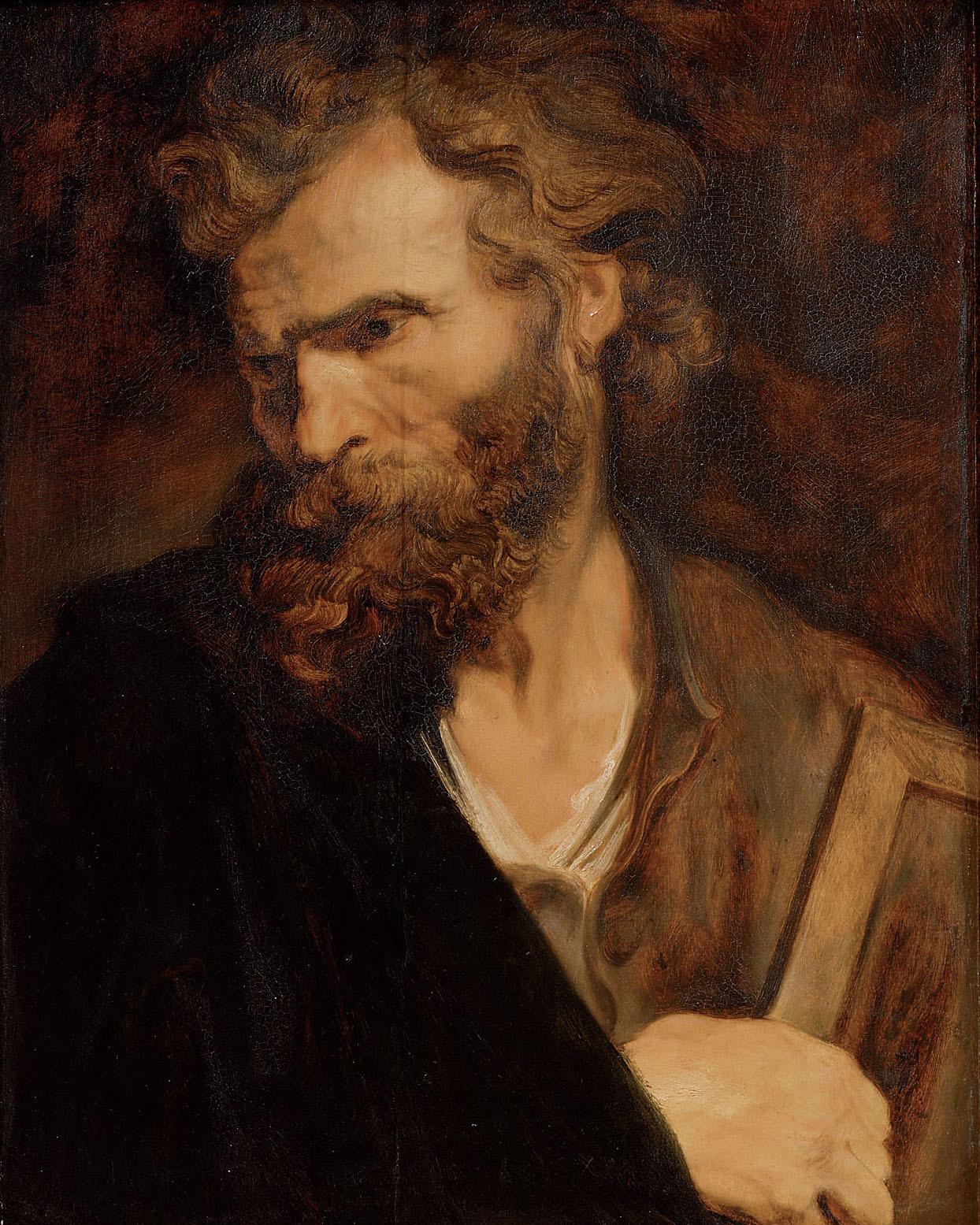
The naming of this apostle is one of the small puzzles of the synoptic lists. Matthew (10:3) calls him 'Lebbaeus, whose surname was Thaddaeus' (the Lebbaeus name appears only in some manuscripts; many critical texts omit it). Mark (3:18) calls him 'Thaddaeus.' Luke (6:16) and Acts (1:13) call him 'Judas of James' — Greek Ioudas Iakōbou, which can mean either 'Judas the son of James' or 'Judas the brother of James.' John (14:22) introduces him as 'Judas, not Iscariot.' The simplest reconstruction is that he had multiple names in different communities — Thaddeus among Greek-speaking Christians, Judas among Aramaic-speaking ones — with the qualifier 'not Iscariot' added in John to distinguish him from the betrayer.
John 14:22 is the only Gospel passage that gives him a speaking role. During the Last Supper, after Jesus speaks of his coming departure and of the love of those who keep his commandments, Judas (not Iscariot) asks: 'Lord, how is it that thou wilt manifest thyself unto us, and not unto the world?' Jesus's reply — 'If a man love me, he will keep my words: and my Father will love him, and we will come unto him, and make our abode with him' — is one of the most intimate descriptions of the Trinitarian indwelling in the New Testament.
The Epistle of Jude in the New Testament is traditionally attributed to him in some readings, though the author identifies himself as 'Judas, the servant of Jesus Christ, and brother of James' (Jude 1:1) — which is closer to the description of Judas as a brother of James the Lord's brother than as the apostle 'Judas of James.' The attribution to the apostle Thaddeus is therefore contested in modern scholarship and was already disputed in the patristic period.
The strongest post-apostolic tradition about Thaddeus is the Abgar legend, preserved by Eusebius (Historia Ecclesiastica I.13). King Abgar V of Edessa (modern Şanlıurfa, Turkey, then in Mesopotamia) heard of Jesus's miracles, wrote him a letter requesting healing, and received in reply a letter from Jesus promising that after his ascension a disciple would come. Eusebius records that after the resurrection, Thomas sent Thaddeus to Edessa, where he healed the king and converted the city, founding the church that became one of the great early Christian centers of Mesopotamia. Eusebius claims to have read the Syriac archives at Edessa himself and to be reproducing the original documents. Modern scholarship treats the letter exchange as legendary, but the early establishment of Christianity at Edessa is historically secure, and the city was an undisputed early apostolic center.
His missionary work is traditionally extended into Armenia and Persia, often paired with Simon the Zealot. The two are said to have been martyred together — Thaddeus by axe or halberd, Simon by being sawn in two. The historicity of the martyrdoms is uncertain; what is certain is that the Armenian and Persian churches honor both apostles as their founders.
In the modern Roman Catholic tradition, Thaddeus (under the name 'Jude') has become the patron of impossible or desperate cases. The origin of this devotion is uncertain; one common explanation is that because his name resembled Judas Iscariot's, no one prayed to him, so his intercession was 'reserved' for cases that no one else would handle. The devotion grew enormously in the 19th and 20th centuries, particularly in the United States, where the National Shrine of St. Jude in Chicago became one of the most-visited Catholic devotional sites of the 20th century.