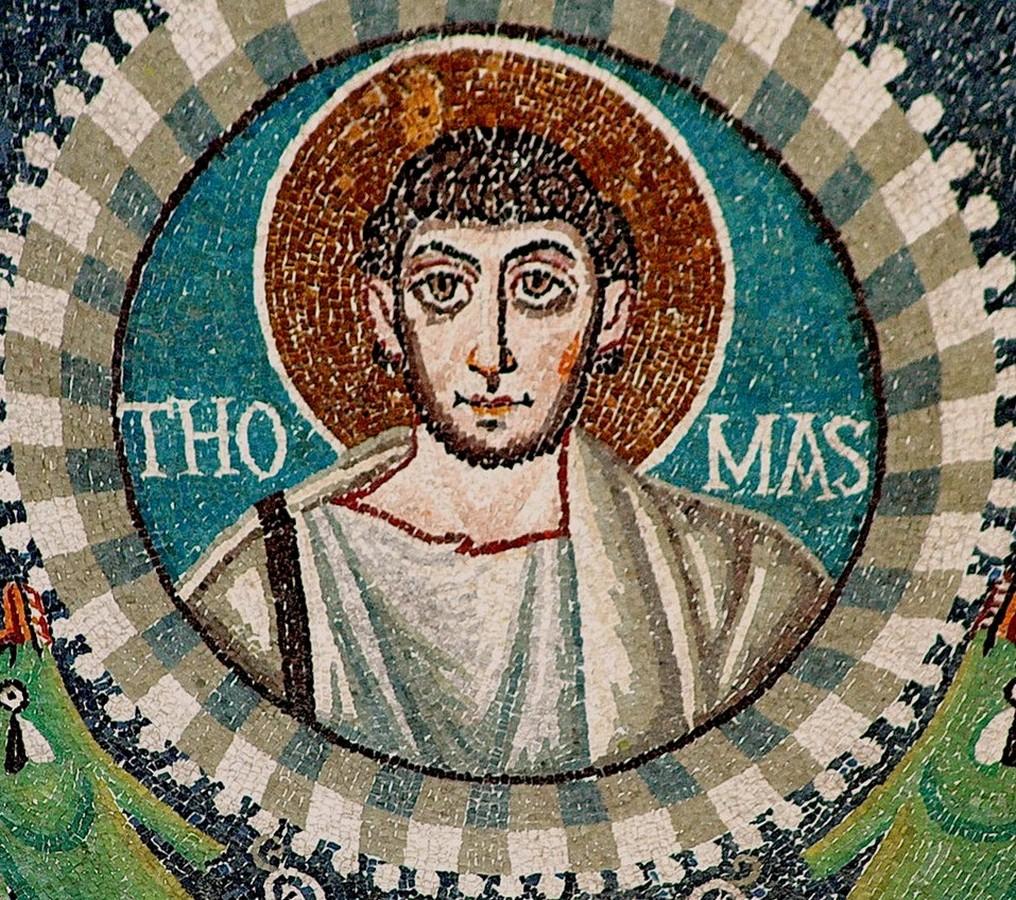
Thomas the Twin (Greek: Didymus, the same word translated from Aramaic Te'oma) is named in all four apostle lists and appears most prominently in the Gospel of John, which records four distinct speeches by him. The English tradition of 'Doubting Thomas' is rooted in just one of those four — John 20:24–29 — and misses the fuller and more complicated portrait the Gospel provides.
In John 11:16, when Jesus determines to go to Bethany after the death of Lazarus (a journey the disciples know to be dangerous because of the Judean authorities' opposition), it is Thomas who says: 'Let us also go, that we may die with him.' This is not the voice of a doubter. It is the voice of a man who is realistic about the cost of discipleship and willing to bear it. The same Thomas appears in John 14:5, where during the upper room discourse he interrupts Jesus's speech: 'Lord, we know not whither thou goest; and how can we know the way?' The question prompts one of the most quoted statements in the New Testament: 'I am the way, the truth, and the life: no man cometh unto the Father, but by me.' Thomas, in this episode, is the asker of the question that makes the Christological self-disclosure possible.
The 'doubt' episode is in John 20:24–29. Thomas is absent when the risen Christ first appears to the disciples in the upper room. When the others tell him they have seen the Lord, he responds: 'Except I shall see in his hands the print of the nails, and put my finger into the print of the nails, and thrust my hand into his side, I will not believe.' Eight days later Jesus appears again, this time with Thomas present, and offers his wounds for examination: 'Reach hither thy finger, and behold my hands; and reach hither thy hand, and thrust it into my side: and be not faithless, but believing.' Thomas's response is the most theologically charged confession of Christ's divinity in any of the Gospels: 'My Lord and my God' (Ho Kyrios mou kai ho Theos mou). The apostle who demanded the proof produces the highest confession.
The post-apostolic tradition takes Thomas to India. The Acts of Thomas (early third century, originally in Syriac) records a detailed narrative of his mission to Parthia and then to the kingdom of King Gondophares in northwest India. This king was long assumed to be legendary, but in 1834 an inscription was discovered confirming that a Gondophares (Gondopharnes) actually ruled the Indo-Parthian kingdom in northwest India from approximately 19 AD to 46 AD — the period at which an apostolic mission would have been possible. The discovery substantially raised the historical credibility of at least the framework of the Thomas tradition.
The strongest tradition is the Mar Thoma Christianity of Kerala in southwest India — the Saint Thomas Christians, who trace their community directly to Thomas's mission in 52 AD. They maintain a continuous Indian Christian tradition that predates the arrival of any European missionary by approximately fifteen hundred years. Their core sites are Cranganore (where Thomas is said to have landed), seven 'Mar Thoma' churches he is said to have founded, and Mylapore (near modern Chennai), where he was speared to death and buried. The tomb at Mylapore was venerated continuously through the medieval period, was visited and described by Marco Polo in 1293, and is now the location of the San Thome Basilica.
His iconographic attributes are the spear or lance (the manner of his martyrdom) and the carpenter's square — a reference to the apocryphal Acts of Thomas tradition that he was a carpenter or builder by trade, and to a story in the Acts in which he is sent by King Gondophares to build a palace, which Thomas instead gives away as alms to the poor, telling the king the palace exists in heaven.