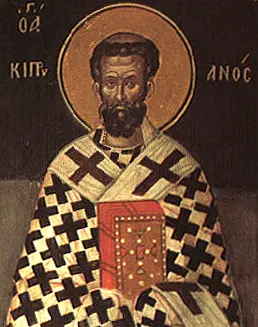
Cyprian of Carthage
A trained orator turned bishop who steered the church through persecution and schism — and gave the West its enduring (and contested) language of church unity.
“He cannot have God for his Father who does not have the Church for his Mother.”
— On the Unity of the Catholic Church
Cyprian was a wealthy, classically trained rhetorician in Carthage who converted in middle age, gave much of his estate to the poor, and within a few years was made bishop of the most important see in Latin Africa. His episcopate was a storm: the Decian persecution scattered his flock, and afterward the church was torn over what to do with the 'lapsed' — those who had sacrificed to the gods under threat and now wanted back in.
Cyprian charted a middle way between rigorists who would never readmit them and laxists who would readmit them cheaply: real repentance, a process of restoration, and the bishop's discernment. The crisis pressed him to think hard about the church itself. In On the Unity of the Catholic Church he argued that schism is a grave evil and that the bishops, holding the one episcopate in common, are the visible bond of the church's unity — coining the much-quoted (and much-debated) line, 'He cannot have God for his Father who does not have the Church for his Mother.'
He clashed with Rome over whether baptism by heretics was valid (Cyprian said no), a dispute left unresolved at his death. When persecution returned under Valerian, Cyprian refused to flee or recant. In 258 he was beheaded outside Carthage — the first African bishop to be martyred — having told the proconsul simply, 'I am a Christian and a bishop. I know no other gods.' His writings shaped Western ecclesiology for centuries, and every tradition still argues over how far his vision of the bishop and the church should be pressed.
- The unity of the church grounded in the shared episcopate
- Discipline and restoration of the lapsed through real repentance
- The gravity of schism as a sin against the body of Christ
- Martyrdom and confession as the crown of Christian fidelity
Born to a wealthy pagan family in Carthage
Converts to Christianity; gives wealth to the poor
Elected bishop of Carthage
Goes into hiding during the Decian persecution
Writes On the Unity of the Catholic Church amid the lapsed controversy
Disputes with Rome over the validity of heretical baptism
Beheaded near Carthage under Valerian
His most influential work, arguing that the church's unity rests on the shared episcopate — a foundation of Western ecclesiology and a perennial point of debate.
A pastoral treatise on restoring those who renounced Christ under persecution — repentance with discipline, neither rigorism nor laxity.
A large correspondence documenting the life, discipline, and controversies of the third-century African church in vivid detail.