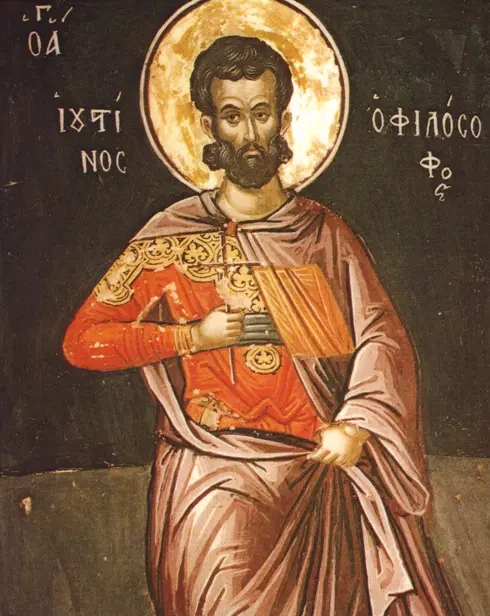
Justin Martyr
The first great Christian philosopher — a convert who kept his philosopher's cloak and argued that all truth, wherever found, belongs to Christ the Logos.
“Whatever things were rightly said among all men, are the property of us Christians.”
— Second Apology
Justin was born around 100 in Flavia Neapolis (ancient Shechem, in Samaria) to a pagan family. He hunted for truth through the philosophies of his day — Stoic, Peripatetic, Pythagorean, Platonist — until, by his own account, an old man by the sea pointed him beyond philosophy to the prophets and to Christ. He converted, but kept wearing the philosopher's cloak: for Justin, Christianity was the true philosophy, not the abandonment of the search but its end.
He taught in Ephesus and then opened a Christian school in Rome, writing for emperors and pagans alike. His First and Second Apology defended Christians against the charges of atheism and immorality and described their worship and baptism in detail — among the earliest windows we have into how the early church actually gathered. His Dialogue with Trypho is a long, courteous debate with a Jewish interlocutor over whether Jesus is the promised Messiah.
Justin's boldest idea was the logos spermatikos — the 'seed of the Word.' Because Christ is the Logos through whom all things were made, every fragment of truth glimpsed by a Socrates or a Plato was a seed of the same Word who became flesh. Pagan wisdom was not Satan's counterfeit but Christ's down payment. Around 165, refusing to sacrifice to the gods, Justin and several companions were scourged and beheaded in Rome — earning the name by which the church has known him ever since.
- Christ as the Logos through whom all truth comes
- The logos spermatikos — 'seeds of the Word' scattered among the philosophers
- Christianity as the true philosophy
- Earliest detailed witness to Christian worship and the sacraments
Born in Flavia Neapolis (Samaria)
Conversion to Christianity by the sea
Writes the First Apology to Emperor Antoninus Pius
Writes the Dialogue with Trypho
Teaches in Rome; debates the Cynic Crescens
Martyred in Rome under Marcus Aurelius
A defense of Christians to the emperor, including the earliest detailed description of Christian baptism and the Eucharist.
A shorter follow-up answering specific charges and injustices against believers.
An extended, respectful debate with a Jewish scholar over the messiahship and deity of Jesus and the meaning of the Hebrew Scriptures.