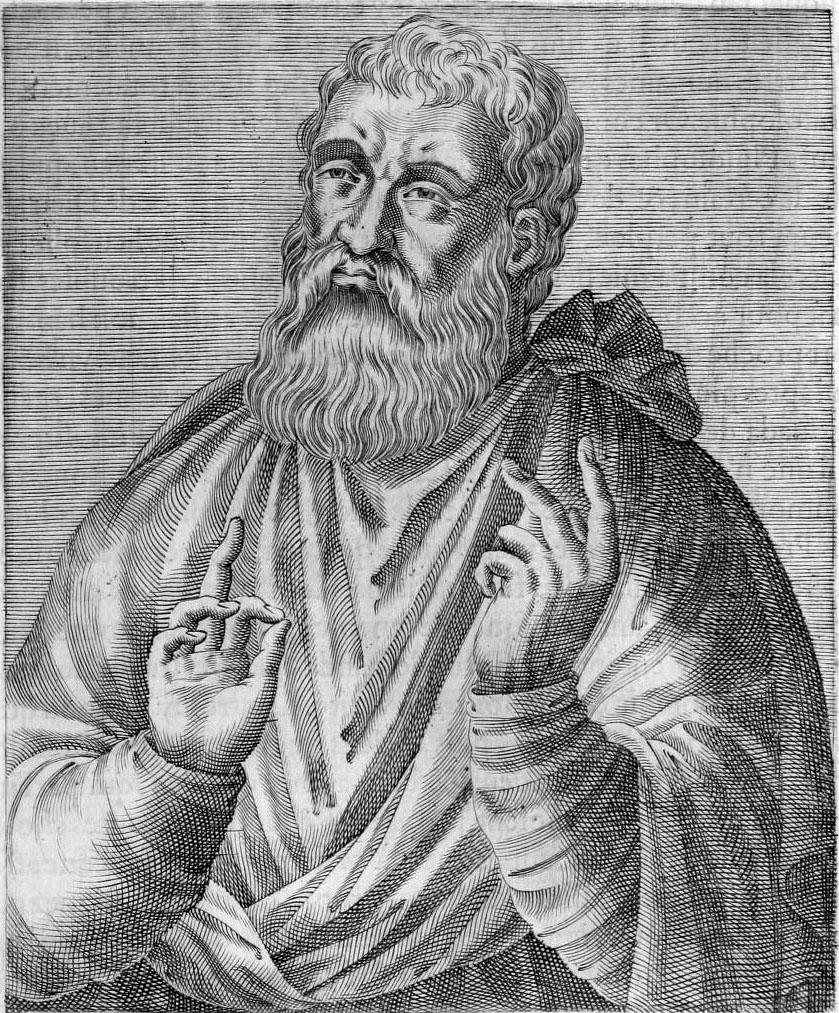
Justin was born in Flavia Neapolis (modern Nablus) in Samaria around 100 AD, to a Greek-speaking pagan family. He recounts in his own writings (the opening of the Dialogue with Trypho) a youth spent moving from one philosophical school to another — Stoicism, Aristotelianism, Pythagoreanism, Platonism — searching for a school that could answer the question of God. Each one disappointed him in turn. He encountered Christianity through an elderly man on a beach who, in the course of a long conversation, persuaded him that the prophets had testified to a divine plan that the philosophers had only dimly perceived.
Justin became a Christian, retained his philosopher's cloak (a deliberate sign that the new faith fulfilled rather than rejected the philosophical quest), and opened a school in Rome around 150 AD. He produced the most important Christian intellectual defense of the second century: the First Apology, addressed to the emperor Antoninus Pius, defending Christians against the standard charges of atheism, cannibalism, and political subversion; the Second Apology, prompted by a specific case of Christian executions in Rome; and the Dialogue with Trypho, an extended argument with a Jewish interlocutor about whether Jesus is the promised Messiah.
Justin's intellectual contribution was the doctrine of the logos spermatikos — the seed of the divine Word scattered throughout creation, present partially in the wisdom of pagan philosophy (especially in Socrates and Plato), and present fully in the incarnate Christ. This was not religious syncretism. It was an argument that the truths the philosophers had glimpsed were attributable to the same Logos who became flesh in Jesus, and that Christianity was therefore the fulfillment rather than the rejection of the philosophical tradition. The argument has shaped Christian engagement with intellectual culture ever since.
Around 165 AD, Justin was denounced — almost certainly by Crescens, a Cynic philosopher with whom he had debated publicly and humiliated. He was brought before the Roman prefect Junius Rusticus, interrogated, refused to sacrifice to the gods, and was beheaded along with six companions. The Acts of Justin, a court-record style account of the interrogation, survives and is one of the most reliable martyrological documents of the second century. Justin had argued in his Second Apology that Christians did not seek death but did not fear it. He had the opportunity to demonstrate the latter and did.