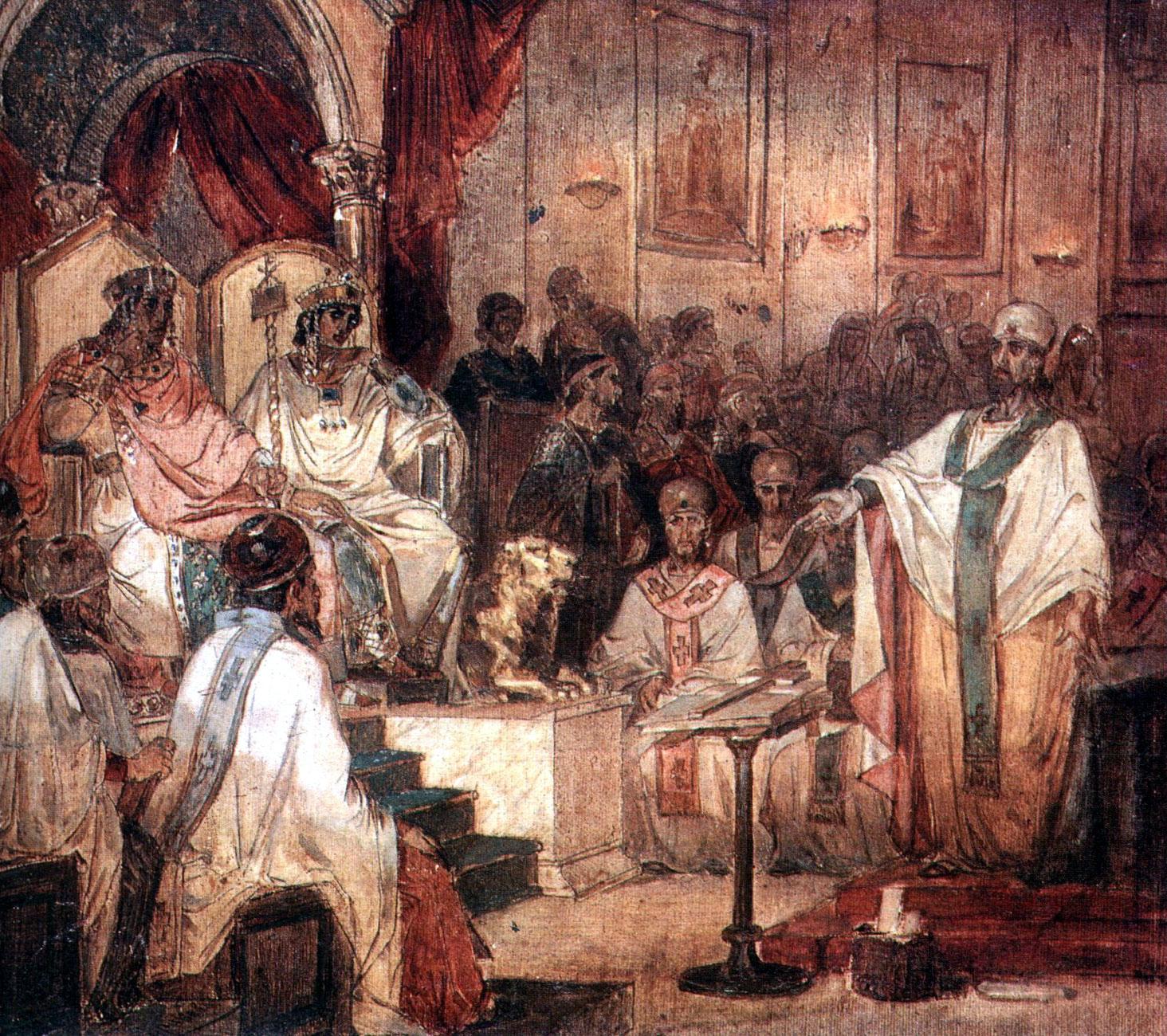
The Council of Chalcedon convened in October 451 AD with approximately 520 bishops in attendance — the largest of the early ecumenical councils. Its purpose was to resolve the Christological controversy that had been escalating since the Council of Ephesus in 431 AD. The dispute concerned how the divine and human natures of Christ relate within his single person. The settlement Chalcedon produced — that Christ is 'in two natures, without confusion, without change, without division, without separation' — became the orthodox position of the imperial church. The churches that rejected this formula became what is now called the Oriental Orthodox communion.
The dispute had a long preface. Cyril of Alexandria, in his battle with Nestorius at the Council of Ephesus (431), had used the formula 'one nature of the incarnate Word' — a phrase borrowed from a sermon he believed was by Athanasius but which was actually by Apollinarius. After Cyril's death in 444, his successor Dioscorus of Alexandria pressed the 'one nature' formula in increasingly strong terms. In 449, at the so-called 'Robber Council' of Ephesus, Dioscorus pushed through the rehabilitation of the monk Eutyches, who taught that Christ's humanity was so absorbed into his divinity that it was no longer like ours — a position the broader church found unacceptable.
Pope Leo I of Rome had written a doctrinal letter — the Tome to Flavian — that articulated the Western Christological position with great precision: in Christ there are two natures, divine and human, fully preserved in one person, each nature performing what is proper to it in communion with the other. Leo's tome was not read at the 449 council, where the Roman legates were intimidated and Dioscorus prevailed. After the death of the emperor Theodosius II in 450, the new emperor Marcian and his wife Pulcheria convened a new council at Chalcedon, just across the Bosphorus from Constantinople, specifically to overturn the 449 decisions.
The Chalcedonian Definition is one of the most carefully worded theological documents in Christian history. It affirms that Christ is 'truly God and truly man, of a reasonable soul and body, consubstantial with the Father according to the Godhead, and consubstantial with us according to the Manhood... acknowledged in two natures, without confusion, without change, without division, without separation; the distinction of natures being by no means taken away by the union, but rather the property of each nature being preserved, and concurring in one Person and one Subsistence, not parted or divided into two persons, but one and the same Son.' The four negative adverbs — without confusion, without change, without division, without separation — define the position by ruling out four opposing errors: Eutychian absorption (confusion), Apollinarian incomplete humanity (change), Nestorian division (division), and any failure of personal unity (separation).
The non-Chalcedonian churches did not accept this language. They preferred Cyril's formula — 'one incarnate nature of the divine Word' — and read the Chalcedonian 'two natures' formula as a concession to Nestorianism. Their position, properly understood, is not the Eutychian heresy that the Chalcedonian council condemned. It is what modern theologians call miaphysitism (from mia, 'one,' physis, 'nature') — the doctrine that the divine and human natures of Christ are united in one composite nature, without confusion or alteration. The miaphysite position holds that Cyrilline language is sufficient and that the Chalcedonian addition is unnecessary, divisive, and risks reopening the Nestorian door.
The schism became permanent over the following century. Imperial pressure for conformity to Chalcedon alienated the Coptic, Syriac, and Armenian populations. Severus of Antioch (c. 465–538) became the principal theologian of the miaphysite tradition; his exile and the suppression of his communities under Justin I and Justinian I hardened the division. By the end of the 6th century, separate hierarchies had been established. The Arab conquests of the 7th century left the miaphysite communities under Islamic rule, where they survived but lost their imperial ties.
The modern ecumenical movement has substantially reconciled the Chalcedonian and miaphysite traditions at the theological level. The 1989 Joint Christological Declaration between the Roman Catholic Church and the Coptic Orthodox Church, and similar agreements with the Syriac and Armenian Orthodox, acknowledge that the two traditions confess the same Christological faith using different terminology. The Chalcedonian / non-Chalcedonian division is therefore now widely understood by historians and theologians as substantially a linguistic-political rupture rather than a deep doctrinal one — though the institutional separation remains, and full communion has not been restored.