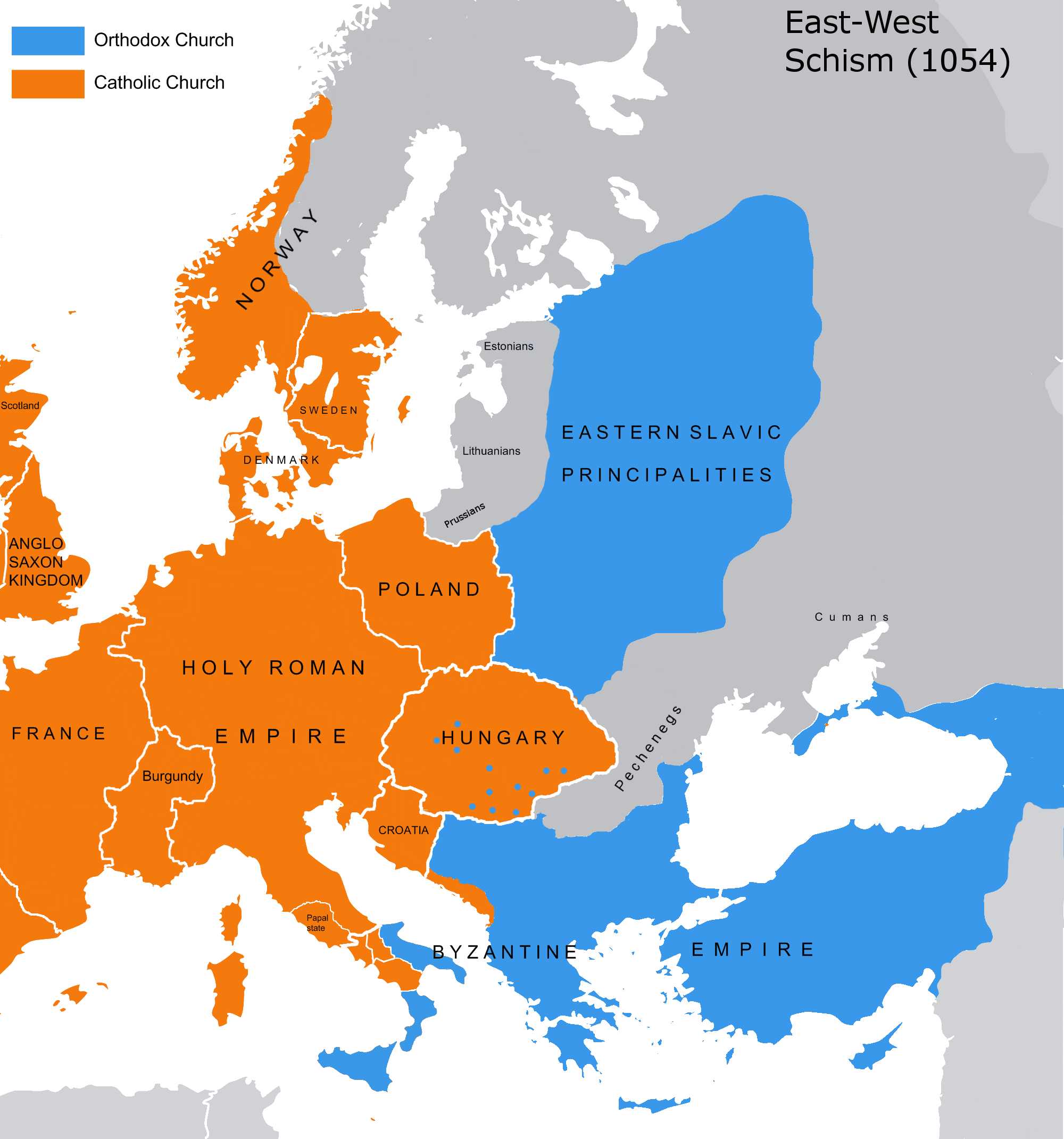
The Great Schism of 1054 is the most famous date in Christian church history, and the most misleading. The actual reciprocal excommunications of 16 July 1054 — between the legates of Pope Leo IX (who was already dead by the time they were delivered) and Patriarch Michael Cerularius of Constantinople — affected only the persons named in the documents, not the entire Western or Eastern churches. The two communions did not regard themselves as definitively separated for another two centuries. What 1054 actually marks is not the rupture but the moment when the long, slow drift between Rome and Constantinople became visible at the highest official level.
The drift had begun much earlier. Linguistic divergence: by the 4th century, Latin had displaced Greek as the working language of Western Christianity, and most Western theologians could not read the Greek Fathers. Liturgical divergence: the Western use of unleavened bread for the Eucharist and the Eastern use of leavened became a contested issue. Political divergence: the imperial center moved to Constantinople in 330, but Rome retained the prestige of apostolic memory and the see of Peter. Theological divergence: the Latin West, especially after Augustine, developed an Augustinian theology of original sin, grace, and merit that the Greek East largely did not share.
The most concrete doctrinal dispute was the filioque clause. The original Niceno-Constantinopolitan Creed of 381 confessed that the Holy Spirit 'proceeds from the Father.' Beginning in the 6th-century Spanish church and spreading through the Frankish Empire under Charlemagne, the Latin West added 'and from the Son' (Latin: filioque). This was first accepted into the Roman creed under Pope Benedict VIII in 1014. The East regarded the unilateral alteration of an ecumenical creed by a single patriarchate as a procedural violation of conciliar order, and the theological substance — the procession of the Spirit from both Father and Son rather than only from the Father — as a substantive deviation from the patristic consensus. The filioque remains the single most consistently named doctrinal cause of the schism.
The 9th-century Photian schism prefigured 1054. Photius of Constantinople (c. 810–893), patriarch from 858–867 and again from 877–886, contested papal claims of universal jurisdiction and explicitly attacked the filioque in his Mystagogy of the Holy Spirit. The dispute was eventually patched, but the underlying questions were not resolved.
The 1054 events were precipitated by the Norman conquests in southern Italy, where Greek-rite Christians lived under Latin political rule. Cerularius closed the Latin churches in Constantinople in retaliation for the Latinization of Greek churches in Italy. Pope Leo IX sent a delegation under Cardinal Humbert of Silva Candida to negotiate. The negotiation collapsed. Humbert and his colleagues marched into Hagia Sophia during the divine liturgy on 16 July 1054 and placed a bull of excommunication on the altar. The bull excommunicated Cerularius and his named supporters by name. Cerularius convened a synod and reciprocated, excommunicating Humbert and the legates by name. Both sides spoke as if their actions affected only specific persons; neither claimed at the moment to have excommunicated the entire other communion.
The schism became practically irrevocable through the Fourth Crusade. In 1204, a crusading army of Western Christians, originally bound for Egypt, sacked Constantinople — burning the city, looting churches, desecrating the altar of Hagia Sophia, and installing a Latin patriarch on the Constantinopolitan throne for the next six decades. The horror of 1204 burned the East-West division into the deep memory of the Eastern church in a way that no theological argument could have done.
The Second Council of Lyon (1274) and the Council of Florence (1439) attempted reunions on terms substantially favorable to Rome. Both were repudiated by the Greek faithful and clergy after the negotiating delegations returned. The Fall of Constantinople in 1453 ended the imperial framework that had made even the attempted reunions possible.
In 1965, Pope Paul VI and Ecumenical Patriarch Athenagoras I issued a joint declaration lifting the mutual excommunications of 1054 — a symbolic act of healing that did not restore communion but acknowledged the wound. The dialogue continues. The substantive issues — papal primacy, the filioque, the ecclesiology of the local versus universal church — remain unresolved at the formal level.