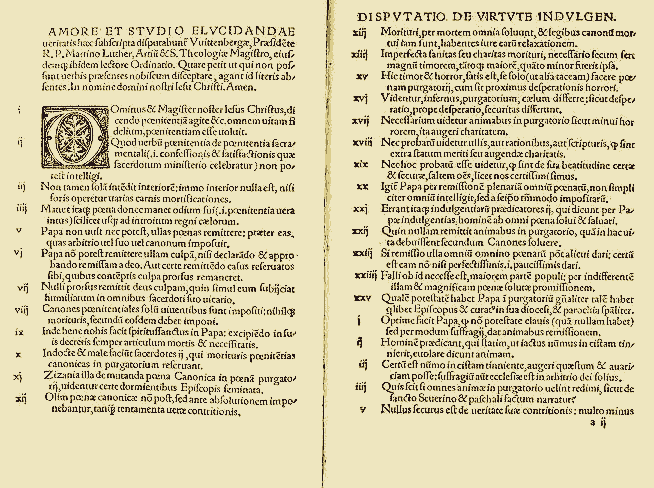
The Protestant Reformation conventionally begins on 31 October 1517, when Martin Luther — an Augustinian friar and professor of biblical theology at the new University of Wittenberg — either posted or sent to his archbishop ninety-five theses for academic debate. The theses challenged the contemporary practice of selling indulgences (papal documents granting remission of temporal punishment for sin), specifically the campaign by the Dominican preacher Johann Tetzel to fund the rebuilding of St. Peter's Basilica in Rome. Luther's argument was both pastoral (the practice exploited the consciences of the poor) and theological (the church does not control the treasury of merit in the way the indulgence system implied).
Within a few years what had begun as a German academic dispute had become a continental movement. Luther's three foundational treatises of 1520 — To the Christian Nobility of the German Nation, The Babylonian Captivity of the Church, and The Freedom of a Christian — articulated a comprehensive theological and ecclesiological program. Justification is by faith alone (sola fide), apart from works of merit. Authority is from Scripture alone (sola scriptura), not from popes or councils unless these are consonant with Scripture. The priesthood belongs to all the baptized (the priesthood of all believers), not to a separate clerical class. The seven sacraments of medieval Catholicism are reduced to two (baptism and the Lord's Supper) which can be securely traced to the Gospel's institutional words. The papacy is identified, in increasingly polemical language as the controversy hardened, with the Antichrist of 2 Thessalonians 2 and Revelation.
Rome's response was excommunication. The papal bull Exsurge Domine (June 1520) condemned forty-one propositions from Luther's writings and gave him sixty days to recant. Luther publicly burned the bull at Wittenberg in December 1520. He was excommunicated by the bull Decet Romanum Pontificem in January 1521 and summoned to the Diet of Worms in April 1521, where in front of the Emperor Charles V he refused to retract: 'Unless I am convinced by the testimony of the Scriptures or by clear reason... I am bound by the Scriptures I have quoted and my conscience is captive to the Word of God. I cannot and I will not retract anything, since it is neither safe nor right to go against conscience.' He was placed under imperial ban — the so-called Edict of Worms — but was sheltered by Elector Frederick the Wise of Saxony at the Wartburg castle, where in eleven weeks he translated the entire New Testament into German.
The Reformation did not remain a Lutheran movement. Within five years of the 95 Theses, parallel reformations had begun in Zürich under Huldrych Zwingli, in Strasbourg under Martin Bucer, and shortly afterward in Geneva under the French exile John Calvin, whose Institutes of the Christian Religion (1536, expanded through five editions until 1559) became the definitive systematic theology of the Reformed tradition. Calvin's Geneva became the model for a thoroughly reformed civic Christianity that would be exported to the Netherlands, Scotland (where John Knox imported it after his return from Geneva in 1559), Hungary, the German Palatinate, and Puritan New England.
The Lutheran and Reformed traditions, though both Protestant, divided sharply over the theology of the Eucharist. Luther held to a 'real presence' of Christ in the bread and wine — Christ is truly present 'in, with, and under' the elements (the formula later called consubstantiation, though Luther himself did not use the term). Zwingli held to a memorial or symbolic view — the bread and wine are signs and seals of a Christ who is bodily ascended and not physically present in the elements. The Marburg Colloquy of 1529 attempted to reconcile the two positions and failed; the two streams of Protestantism never came back together.
England's Reformation began as a political and dynastic act rather than a theological movement. Henry VIII, denied an annulment of his marriage to Catherine of Aragon, broke with Rome in 1534 with the Act of Supremacy and declared himself Supreme Head of the Church in England. The early English settlement under Henry was Catholic in doctrine but English-administered. The theological reformation was driven by Archbishop Thomas Cranmer, especially during the reign of Edward VI (1547–1553) when the first two editions of the Book of Common Prayer (1549 and 1552) gave Anglicanism its distinctive liturgical shape. Mary I's brief Catholic restoration (1553–1558) ended with Cranmer's execution; Elizabeth I's settlement (1559–1603) consolidated a moderate Reformed Anglicanism that has remained the substantial center of the tradition.
The radical or Anabaptist wing of the Reformation insisted that the magisterial Reformers had not gone far enough. They rejected infant baptism as unscriptural and re-baptized adult believers (the term 'Anabaptist' means 're-baptizer'). They refused civil-magistrate enforcement of religion, oath-taking, and military service. They held strict communities under church discipline. The Schleitheim Confession (1527) articulated their position. Both Catholics and Protestants persecuted them violently; the spectacular collapse of the radical regime at Münster in 1534–1535 set Anabaptism back for a generation, but Menno Simons's quietist reorganization (whence 'Mennonite') preserved the tradition into the modern Mennonite, Amish, Hutterite, and Brethren denominations.
Rome's response was the Counter-Reformation, focused above all on the Council of Trent (1545–1563). Trent reaffirmed Catholic doctrine against the Protestant challenges — the seven sacraments, the dual authority of Scripture and Tradition, the role of works alongside faith in justification, the propitiatory character of the Mass — while undertaking serious internal reform of clerical discipline, episcopal residence, and seminary education. The new religious orders, especially the Jesuits founded by Ignatius of Loyola in 1540, became the missionary and educational engine of post-Tridentine Catholicism. The post-Trent Catholic Church remained recognizably the church of the medieval West but with a level of doctrinal precision and institutional discipline it had not previously possessed.
The political consequences of the Reformation were enormous. The wars of religion that followed — the Schmalkaldic War (1546–1547), the French Wars of Religion (1562–1598), the Eighty Years' War in the Netherlands (1568–1648), and above all the Thirty Years' War (1618–1648) — killed millions and reshaped the political map of Europe. The Peace of Westphalia in 1648 settled the religious geography of central Europe along the principle cuius regio, eius religio ('whose realm, his religion') — the ruler of each territory determined its confession. The principle of state-church identification it established, and the principle of confessional toleration that gradually emerged to qualify it, are foundational for the modern European state system and for the eventual disestablishment of religion in the Anglo-American constitutional tradition.