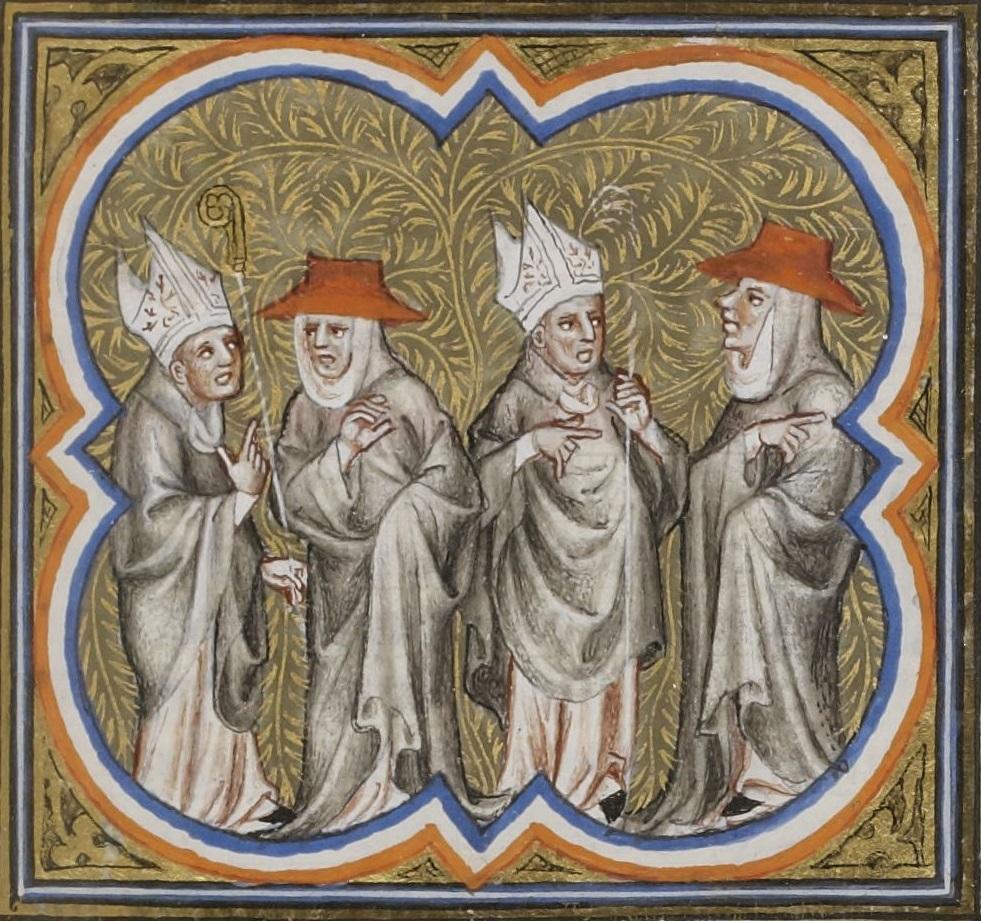
The Western Schism, sometimes called the Great Schism of the West to distinguish it from the East-West rupture of 1054, was a thirty-nine-year crisis within the Roman Catholic Church during which two and eventually three rival popes claimed legitimate authority simultaneously. Unlike the Chalcedonian and 1054 schisms, this one did not produce a lasting denominational division — it was resolved by the Council of Constance in 1417 — but it permanently changed how Christendom thought about the relationship between the papacy and ecclesiastical councils.
The crisis grew out of the seventy years of the Avignon Papacy (1309–1377), during which the popes had lived in southern France under heavy French royal influence. In 1377, under pressure from St. Catherine of Siena and the political weight of returning the papacy to Italy, Pope Gregory XI moved the papal court back to Rome. He died there in March 1378, having issued no instructions for the conclave.
The conclave that followed met in Rome under conditions of intense pressure from the Roman populace, which demanded an Italian pope. The cardinals — most of whom were French — elected Bartolomeo Prignano, the Archbishop of Bari, on 8 April 1378. He took the name Urban VI. Within months, his erratic and increasingly tyrannical behavior toward the cardinals had alienated almost all of them. By August, the French cardinals had withdrawn from Rome, declared the April election invalid as having been performed under duress (specifically: under threat from the Roman mob), and elected a new pope, Robert of Geneva, who took the name Clement VII. Both popes claimed legitimacy. Both excommunicated each other. Western Christendom was forced to choose sides.
The political alignment was almost entirely along national lines. France, Spain (Castile and Aragon), Scotland, and the Kingdom of Naples supported Clement VII at Avignon. The Holy Roman Empire (especially the imperial heartland), England, Portugal, Hungary, Poland, Bohemia, Scandinavia, and most of Italy supported Urban VI at Rome. Each line continued to elect successors as popes died. By 1394, the schism had passed from the original disputants into the second generation: Clement VII was succeeded at Avignon by Benedict XIII, and Urban VI was succeeded at Rome by Boniface IX. Various attempts at reconciliation — by conference, by joint abdication, by withdrawing obedience — all failed.
A breakthrough seemed possible in 1409 when cardinals from both obediences convened a council at Pisa, declared both reigning popes deposed, and elected a third, Alexander V. The Pisan council's authority depended on a conciliarist argument: that an ecumenical council holds authority over the pope and can depose him. But neither Benedict XIII (Avignon) nor Gregory XII (the Roman line by then) accepted the Pisan deposition. The result was three popes simultaneously — Roman, Avignon, and Pisan — each claiming to be the legitimate Vicar of Christ.
The Council of Constance (1414–1418), convened by Emperor Sigismund, finally resolved the schism. The Pisan line's John XXIII (one of the two papal claimants named John XXIII — the modern 20th-century pope of the same name took the number to signal Constance's claimant as illegitimate) was deposed for his manifest misconduct. The Roman line's Gregory XII formally abdicated on the condition that the council acknowledge his line as the legitimate one — a face-saving recognition that the council accepted. The Avignon line's Benedict XIII refused to abdicate but was deposed by the council. With all three claimants out of the way, the council elected a single new pope, Martin V, in 1417.
Constance also produced two of the most consequential decrees in medieval ecclesiology. Haec Sancta (1415) declared that a general council, lawfully convened, has authority directly from Christ that every Christian — including the pope — is bound to obey 'in matters concerning faith, the eradication of the said schism, and the general reform of the said Church of God in head and members.' Frequens (1417) mandated regular future councils to keep this conciliar oversight alive. Together they articulated what became known as conciliarism — the position that the church's supreme authority is held by ecumenical councils, not by the pope acting alone.
The conciliarist movement was a permanent legacy of the schism, though Rome would spend the next several centuries containing and ultimately repudiating it. The First Vatican Council (1869–1870), in defining papal infallibility, definitively closed the conciliarist door from a Roman Catholic perspective. But the Western Schism remains as the single most powerful historical reminder that the relationship between papal and conciliar authority is not a question 19th-century Catholic dogma settled out of nothing — it was forced into systematic theology by the lived crisis of having three popes at once for nearly a decade.