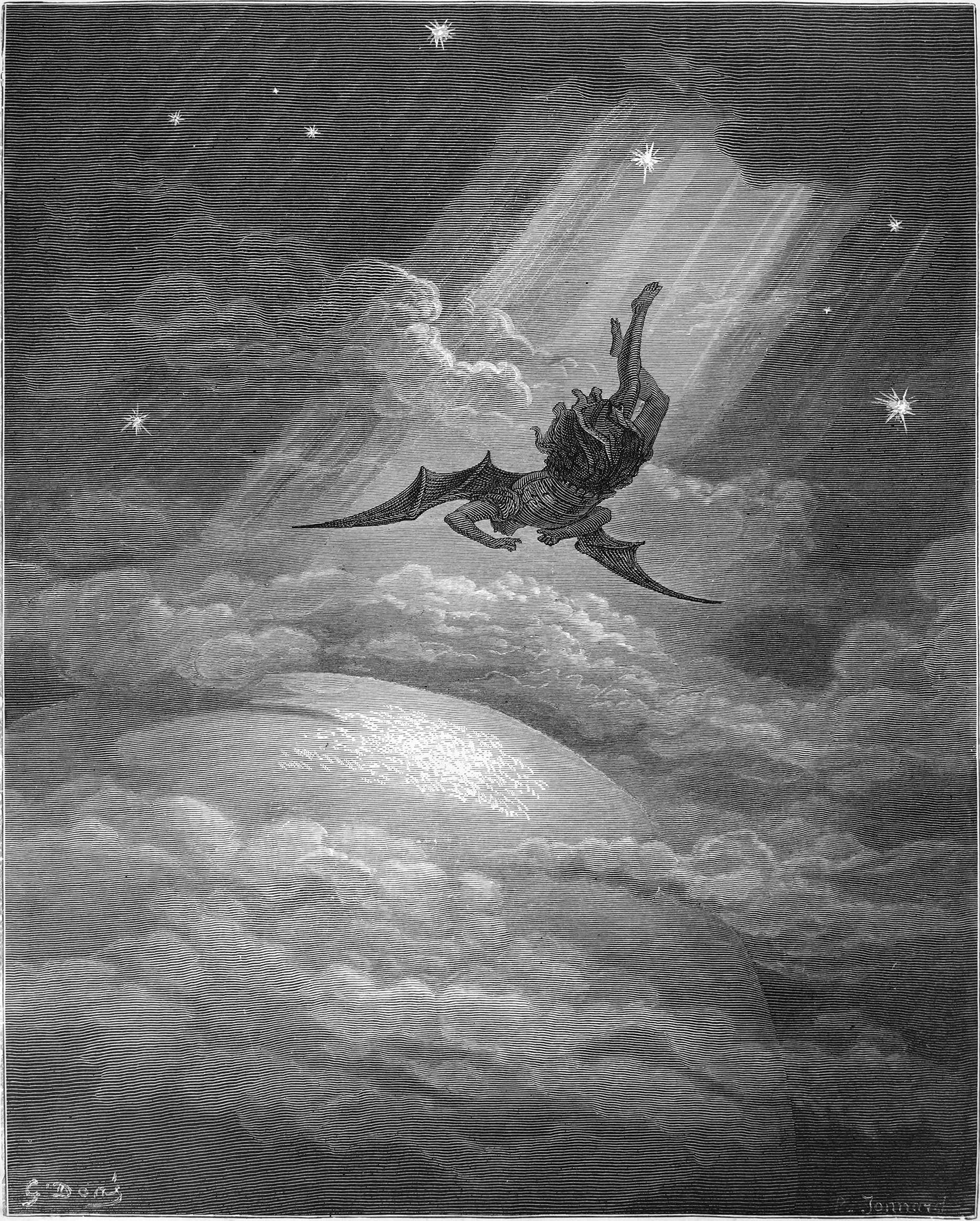
'Lucifer' is the Latin Vulgate rendering of the Hebrew hêlēl ben shaḥar — 'shining one, son of the dawn' — in Isaiah 14:12. The Hebrew is a single occurrence; the word hêlēl is rare and probably derives from the root for 'to shine' or 'to boast.' In the original context, the passage is a taunt against the king of Babylon, not a description of a fallen angel: 'How art thou fallen from heaven, O Lucifer, son of the morning! How art thou cut down to the ground, which didst weaken the nations!' The figure who 'fell from heaven' was a human king whose pride brought him down.
The identification with the devil is a development of patristic exegesis, beginning with Origen (De Principiis I.5) and consolidated by Tertullian, Jerome, and Augustine. They read Isaiah 14 typologically as describing the prince of Babylon and, through him, the spiritual prince behind earthly pride — Satan himself. The exegetical move was not arbitrary. The Isaiah passage's language of cosmic descent ('I will ascend into heaven, I will exalt my throne above the stars of God') reads naturally as a description of an angelic, not merely human, rebellion. The patristic reading became the standard reading for fifteen hundred years and remains so in popular Christian imagination.
The stronger scriptural ground for the figure of a fallen anointed angelic being is Ezekiel 28:11–19, the lament over the king of Tyre. The passage describes the king as having been 'in Eden the garden of God,' 'the anointed cherub that covereth,' 'perfect in beauty,' 'perfect in thy ways from the day that thou wast created, till iniquity was found in thee.' The cosmic and pre-historical character of the description goes well beyond what could be predicated of a contemporary Phoenician monarch, and patristic tradition read this lament, like Isaiah 14, as describing both the human king and the spiritual being behind him. Origen, Jerome, and Augustine all read Ezekiel 28 as containing a description of Satan in his original state as the chief of the Cherubim.
The classification of Lucifer as a Cherub rather than a Seraph or an Archangel is therefore an exegetical conclusion from Ezekiel 28's 'anointed cherub.' Pseudo-Dionysius the Areopagite, working within this framework, placed the rebel chief in the highest of the three triads of the celestial hierarchy. The fall was not from a low position; it was from the closest possible proximity to the divine throne. This is part of why the rebellion is so theologically grave: the being closest to the source of light became the chief opponent of the light.
Luke 10:18 records Christ's own description of the fall: 'I beheld Satan as lightning fall from heaven.' The Greek tense (aorist) describes a completed action — Jesus is recalling, not predicting. Some patristic commentators read this as a reference to a pre-historical fall before creation; others, especially in modern scholarship, read it as a present-moment statement about the cosmic effect of the disciples' mission. The Apocalypse of John 12:7–12 puts the war and the fall in the future, as part of the eschatological vindication of Christ. Whether the fall is pre-creation, contemporary with Christ's ministry, or future is one of the perennial questions of patristic theology; the answer most commonly given is 'all three' — that the fall has multiple temporal aspects in the divine economy.
The composite Christian picture of Lucifer — anointed cherub, morning star fallen from heaven, dragon cast down in Revelation 12 — is therefore a synthesis of multiple texts, not a single biblical passage. It coheres with the broader scriptural witness to a fallen rebellion in the heavenly realm (Luke 10:18, 2 Peter 2:4, Jude 1:6, Revelation 12), but the specific Latin name 'Lucifer' belongs to the Vulgate tradition rather than to Hebrew Scripture. The Revelation passage that uses 'morning star' positively — 22:16, where Christ identifies himself as 'the bright and morning star' — represents the eschatological inversion: the title Lucifer claimed for himself is one Christ truly possesses, and the rebellion is undone when the true morning star rises.