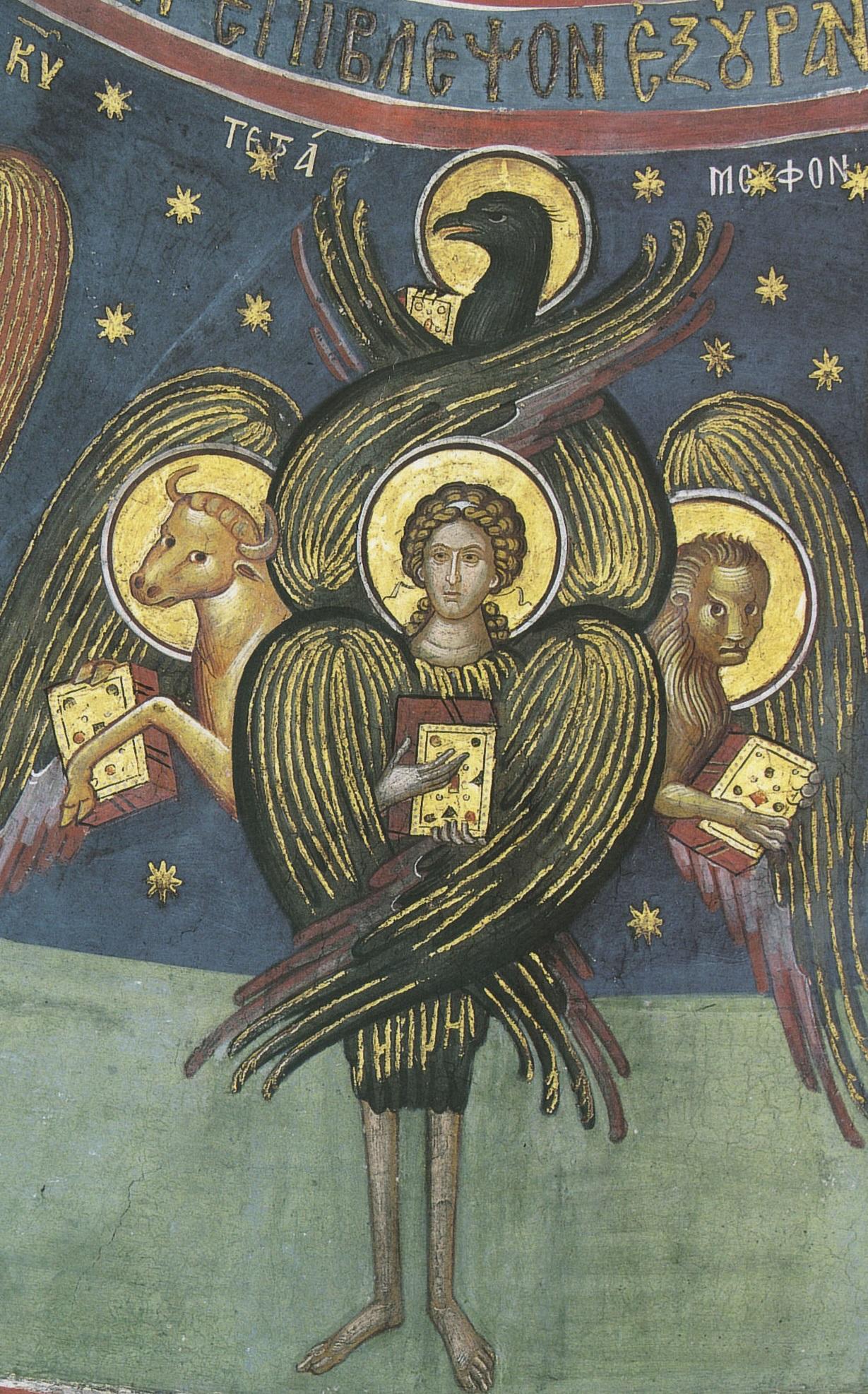
The Cherubim are the most-mentioned class of angelic being in canonical Scripture — appearing 91 times in the Hebrew Bible — and the most thoroughly described. They first appear in Genesis 3:24, immediately after the expulsion of Adam and Eve from Eden: 'So he drove out the man; and he placed at the east of the garden of Eden Cherubims, and a flaming sword which turned every way, to keep the way of the tree of life.' This first appearance establishes their primary function: guardians of sacred space, the threshold between fallen humanity and the divine presence.
Their second appearance is in the design of the Tabernacle. Exodus 25:18–22 describes the two golden Cherubim that crown the mercy seat above the Ark of the Covenant: 'And thou shalt make two cherubims of gold, of beaten work shalt thou make them, in the two ends of the mercy seat. And the cherubims shall stretch forth their wings on high, covering the mercy seat with their wings, and their faces shall look one to another; toward the mercy seat shall the faces of the cherubims be.' This is the spot from which God speaks to Moses: 'And there I will meet with thee, and I will commune with thee from above the mercy seat, from between the two cherubims which are upon the ark of the testimony.' The Cherubim are therefore not only guardians of sacred space; they frame the very point of divine speech.
Solomon's Temple expanded the Tabernacle pattern enormously. 1 Kings 6:23–28 describes two free-standing wooden Cherubim of olivewood, fifteen feet tall, covered in gold, with wingspans of fifteen feet each so that the wings of each Cherub touched the wing of the other in the center of the Most Holy Place and the outer wings touched the walls. The two Cherubim together formed a single canopy under which the Ark of the Covenant rested.
Ezekiel 1 and 10 give the most elaborate description. Ezekiel, in exile by the river Chebar in 593 BC, sees the throne of God borne aloft by four living creatures, each with four faces (man, lion, ox, eagle), four wings, calf's feet that glow like burnished brass, and wheels-within-wheels (the 'ophanim) beside them. In Ezekiel 10:20, he names them explicitly: 'This is the living creature that I saw under the God of Israel by the river of Chebar; and I knew that they were the cherubims.' The four-faced, four-winged Cherub of the throne-chariot is therefore the same class of being as the two golden Cherubim of the mercy seat — a class that ranges from temple-statuary to throne-bearer to guardian of Eden, with the visual and functional details adjusted to each appearance.
Revelation 4:6–8 returns to the same vision. The four living creatures around the throne — each with one of the four faces of Ezekiel's Cherubim — cry 'Holy, holy, holy, Lord God Almighty, which was, and is, and is to come.' They join the Seraphim's cry from Isaiah 6 in a single eschatological liturgy. The early Church identified the four faces with the four Evangelists, an interpretation that appears already in Irenaeus's Adversus Haereses III.11.8 (c. 180 AD): the man with Matthew, the lion with Mark, the ox with Luke, the eagle with John. This identification became the standard iconographic program of medieval Gospel manuscript illumination, the four Evangelist symbols flanking the figure of Christ in mandorla compositions like the Lindisfarne Gospels.
Patristic theology, especially via Pseudo-Dionysius, placed the Cherubim as the second order of the first (highest) triad of the celestial hierarchy — second only to the Seraphim. Their distinctive function is the contemplative reception and transmission of divine wisdom. 'Cherubim' was read in patristic etymology — though disputed by modern Hebraists — as related to a root meaning 'fullness of knowledge.' They are, in this reading, the angelic order that receives the divine wisdom most directly after the Seraphim and transmits it downward through the hierarchy.
The chubby winged infants known as 'cherubim' in Renaissance and Baroque art are not Cherubim. They are putti — a classical motif borrowed from Greco-Roman erotic art (the figures of Cupid and his companions) and Christianized into decorative angelic infants in the late medieval and early Renaissance period. The actual scriptural Cherubim are formidable, multi-faced, four-winged guardians whose presence in Ezekiel's vision so overwhelms the prophet that he falls on his face. The visual confusion between Cherubim and putti is one of the most consequential iconographic shifts in Western Christian art — and one of the most theologically distorting.