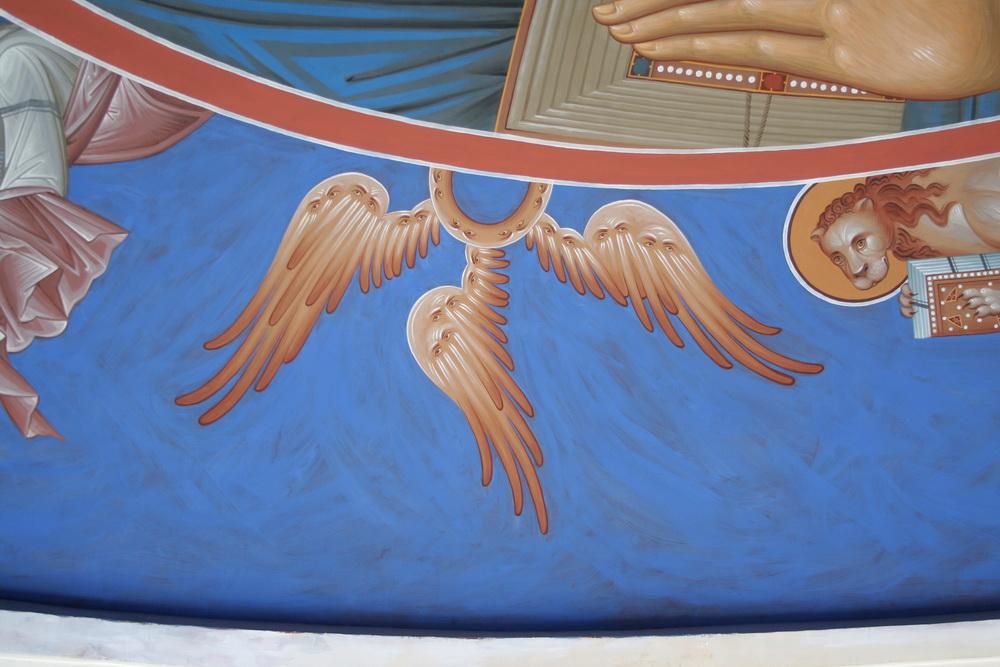
The Thrones are the third order of the highest sphere of the celestial hierarchy, ranked alongside the Seraphim and the Cherubim in the immediate presence of God. Where the Seraphim burn with worship and the Cherubim guard the divine glory, the Thrones bear the seat itself — they are the place where the judgment of God comes to rest. Paul names them explicitly in Colossians 1:16 — 'For by him were all things created… whether they be thrones, or dominions, or principalities, or powers' — listing them at the head of the angelic orders he affirms as part of Christ's creation and lordship.
Pseudo-Dionysius, in the Celestial Hierarchy, explains the Thrones as 'free from all earthly stain, perfectly bearing the divine seat.' Their role is not motion but stability — to receive and hold the weight of divine glory, to be the platform upon which God acts in judgment. In Daniel 7:9, the prophet sees thrones set in place before the Ancient of Days takes his seat — a glimpse of the same reality.
Patristic and Byzantine theology often equates the Thrones with the Ophanim of Ezekiel 1 — the eyed wheels of the divine chariot — though Eastern Orthodox liturgy frequently keeps the two distinct. Whether one or two orders, the function is the same: the Thrones are the visible foundation of the throne of God in the heavens, ministers of justice and the stable point from which divine government proceeds.
Christologically, the Thrones are subsumed under Christ's lordship at the resurrection — Ephesians 1:21 declares him exalted 'far above all principality, and power, and might, and dominion, and every name that is named.' The seat from which judgment flows is now occupied by the Lamb who was slain.