Articlepublished
Pelagius vs. Augustine: The War Over Grace
By Christian Garces2026-05-145 min read
Release2026-05-14
Read time5 min read

The Sentence That Started a War
The controversy began with one line in Augustine’s Confessions: "Give what you command, and command what you will" (da quod iubes et iube quod vis).[1] Pelagius, a British-born ascetic and respected spiritual director in Rome, encountered the prayer some time around 405 and recoiled. To Pelagius’s ear, it sounded like a theological abdication of human responsibility — as if Augustine were asking God to do for him what only Augustine could do for himself. If God must give what he commands, then the commandment loses its moral force. The whole moral life of the Christian becomes a kind of waiting.
What Pelagius could not have known is that he was about to provoke the most extensive systematic theology of grace, sin, and human freedom that the Christian tradition has ever produced. Augustine spent the next twenty-five years — until his death in 430 — writing against the Pelagian movement in book after book, letter after letter, council canon after council canon. The body of work that resulted is not a polemic. It is the closest thing to a treatise on the human will that the ancient Church produced.[2]
The Pelagian Position, Stated Fairly
Pelagius’s position has been caricatured for fifteen centuries, mostly by people who have not read him. His surviving works — principally the commentary on Paul’s letters discovered and edited in the early twentieth century — show a careful, scripturally engaged moral theologian, not a brash heretic.[3] His core convictions were these: God created human beings with genuine free will. The commands of Scripture are real commands, addressed to people who are genuinely capable of obeying them. Grace assists obedience but does not produce it; the assistance is offered, but the human will retains the capacity either to accept or to reject. Sin is habit, not inherited corruption. The example of Adam is morally formative for his descendants, but it does not transmit guilt or corrupt the faculty of choice.
The Pelagian position has significant intuitive appeal. It takes human freedom and dignity seriously. It refuses to make God the author of sin. It insists that moral commands only make sense if the commanded actions are possible. And it has real pastoral force: telling people they are helpless is not the same as telling them to repent.
Caelestius and the Hardening of the Position
The position hardened in the hands of Pelagius’s associates. Caelestius, a Roman lawyer turned Pelagian advocate, drew out the implications of the master’s premises with lawyerly precision: if Adam’s sin does not transmit to his descendants, then infants are born free of original sin; if so, infant baptism does not remit guilt that is not there; if Adam’s death is not the consequence of his sin transferred to humanity, then human death is simply a natural process. Caelestius was condemned at the Council of Carthage in 411 for precisely these propositions.[4] Pelagius himself was acquitted at a synod at Diospolis in 415 only by distancing himself from Caelestius and accepting language about grace that Augustine and Jerome believed he did not mean.
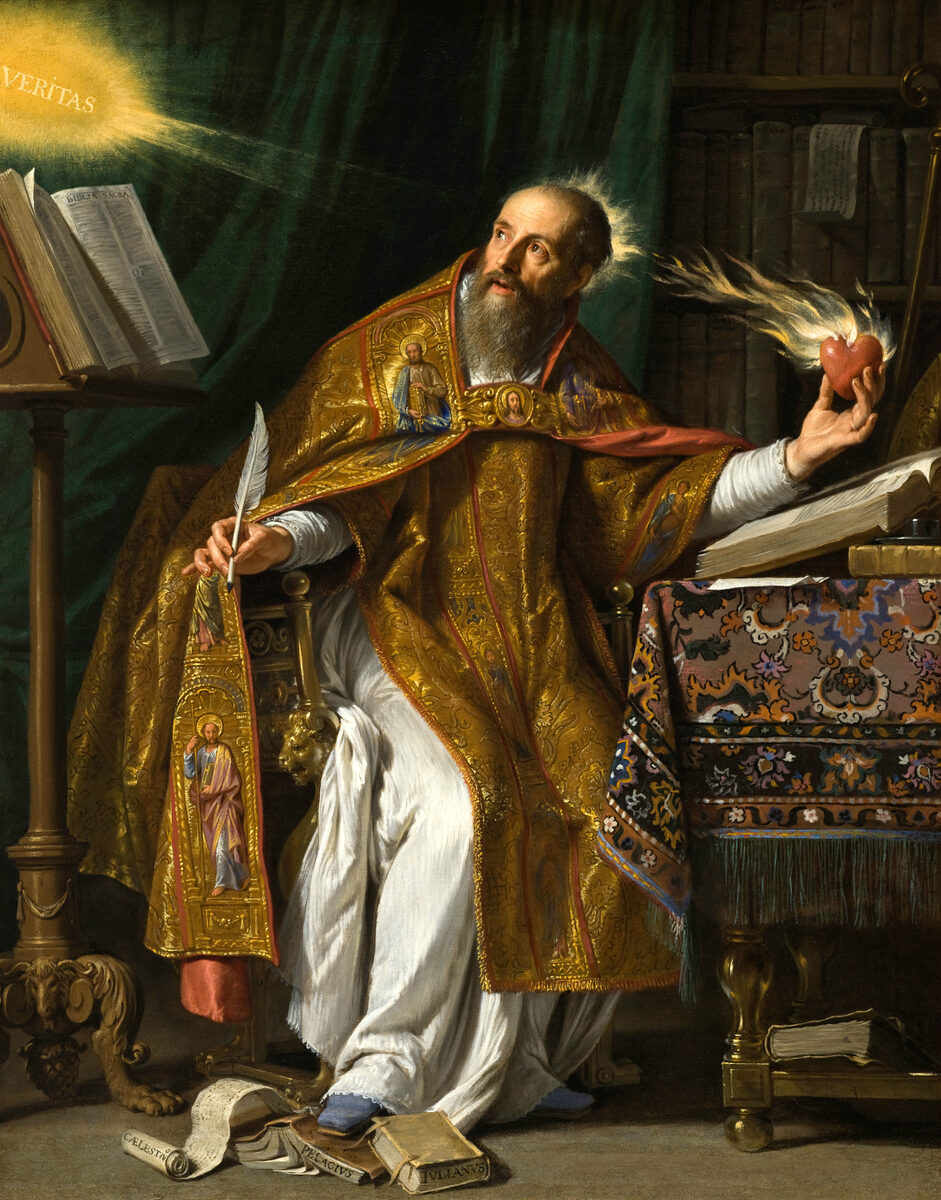
Augustine’s Reply
Augustine’s reply, developed across De peccatorum meritis et remissione (412), De natura et gratia (415), De gratia Christi et de peccato originali (418), De gratia et libero arbitrio (426), De correptione et gratia (426/427), and the late, ferocious Contra Iulianum (421–430), is the most rigorous account of human nature after the Fall that Christian theology has produced.[5]
The Fall, Augustine argues, was not merely an example of bad behavior that set a bad precedent. It was a catastrophe that corrupted the will at its root. Human beings do not merely choose badly; their choosing faculty itself is disordered. They can will lesser goods in some limited sense, but they cannot will the ultimate good — God himself — without a prior divine movement. Grace is not assistance offered to a will that could choose either way; it is the liberation of a will that could not, without it, choose the good at all. Liberum arbitrium, the freedom of choice, remains; libertas, the freedom to actually attain the good, requires grace.
This is why Augustine can both affirm that the will is genuinely free and insist that grace is necessary for any saving good. The two claims are not in tension — they describe two different things. The will is free in the sense that it is unconstrained by external compulsion. It is bound in the sense that, apart from grace, it inevitably wills against its true good. Grace does not coerce the will; it heals it.
The Councils That Set the Boundaries
The Council of Carthage in 418 condemned Pelagianism with a series of canons that became foundational for the Western Church’s doctrine of grace. The Second Council of Orange in 529, working from a draft prepared by Caesarius of Arles and approved by Pope Boniface II in 531, gave the position its most precise expression: original sin is real, the will is genuinely wounded, grace precedes merit, no one can begin to believe without God’s prior gift — and even the desire for grace is itself produced by grace.[6] Orange did not resolve every question. The precise relationship between divine sovereignty and human freedom has continued to be debated in every century since (the Augustinian / Pelagian / semi-Pelagian / Molinist / Reformed / Arminian conversations all draw their categories from this controversy). But Orange set the boundaries outside which Christian theology cannot go.
The Permanent Temptation
Pelagianism in its original form is rare in academic theology today. But its functional equivalent is ubiquitous in popular Christianity: the assumption that salvation is essentially a matter of making good choices, that God helps those who help themselves, that moral effort is what faith is basically about, that the gap between the human and the divine is a matter of degree rather than kind, and that grace is something added to an essentially functional human nature rather than the rescue of a wounded one. Augustine’s answer to this is not despair but gratitude: grace is not a threat to freedom but the only thing that makes real freedom possible. The will that cooperates with grace does not become less free in cooperating — it becomes free at last.
Continue Exploring
Pelagianism is the theology of human capability. Augustine's response is still the most precise account of grace, sin, and freedom that Christian theology has produced.
The Studio Brief
Theology Delivered Weekly
Essays on the Fathers, sacred art, cosmology, and the hidden logic of Christian doctrine — sent directly to your inbox. No noise. No filler.
Weekly
Cadence
Free
Always
Patristic
Focus
Related
Browse Archive
Read
Sacred Art
2026-05-22
The Apostolic Fire
Memory, martyrdom, and the visual language of witness.
Read
Christology
11 min read / 2026-05-17
Why the Lord's Supper Divides Christians
The Eucharist is the most thoroughly attested practice of the earliest Church — and the single sacrament that has done the most to keep Christians apart. The reason is not pettiness. It is Christology.

Read
Christology
10 min read / 2026-05-17
The Jewish Roots of Christian Easter
Easter is not a Christian appropriation of pagan spring rites. It is the Christian fulfillment of the Jewish Passover — and the New Testament insists on this from its earliest layer.