Articlepublished
Marcion and the God He Refused to Accept
By Christian Garces2026-05-142 min read
Release2026-05-14
Read time2 min read
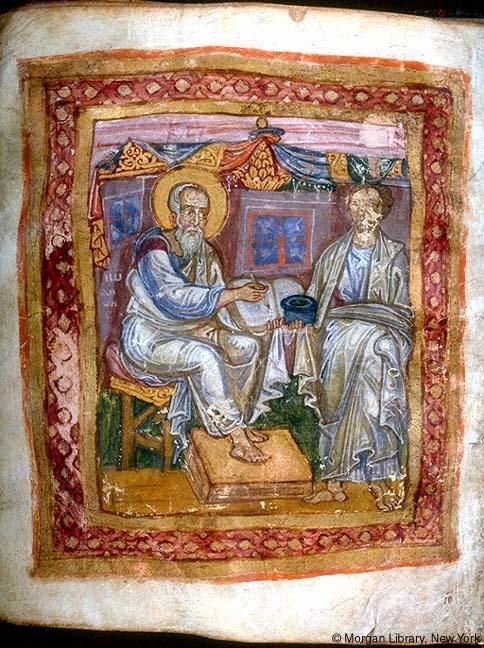
Marcion of Sinope arrived in Rome around 144 AD with a theological system of startling audacity. The god of the Hebrew Scriptures — creator, lawgiver, warrior, judge — was not the God that Jesus called Father. He was a lesser deity: competent enough to make a world, but imperfect, partial, capricious, and tied to a particular people. The true God, hidden and unknown until the coming of Christ, was pure love and mercy — alien to this world and standing entirely outside the Jewish tradition.
The practical consequence of this conviction was a Bible. Marcion produced what may have been the first deliberately assembled Christian canon, consisting of a single Gospel (an edited version of Luke, stripped of birth narratives and Old Testament citations) and ten letters of Paul (edited to remove positive references to the Hebrew Scriptures and the Creator). This was not merely theological preference — it was the logical outcome of a coherent metaphysical system.
Marcion's influence was enormous and immediate. He was excommunicated in Rome and founded his own church, which spread rapidly and lasted for centuries. The shock of his canon may have accelerated the Church's own efforts to define which texts were authoritative. In this paradoxical way, the heretic may have helped produce orthodoxy.
Irenaeus, Tertullian, and Justin Martyr all wrote against Marcion, and their refutations converge on the same point: the God of Jesus and the God of Israel are the same God. The Old Testament is not an obstacle to Christianity but its foundation. The promise and the fulfillment belong together. To rip them apart is not to liberate the Gospel but to destroy it — to make Christ a stranger who arrives from nowhere and saves people from a creation that was already a mistake.
Marcionism haunts Christianity. Every time the Old Testament is treated as spiritually irrelevant, every time 'the God of wrath' is contrasted with 'the God of love' as if they were separate deities, every time Jesus is presented as the correction of rather than the fulfillment of Israel's story — Marcion's ghost is walking. The Church's answer is typology: the whole canon is one story, one God, and one redemptive arc. The cross is where the God of Exodus and the Father of Jesus are revealed to be the same.
Continue Exploring
Marcion of Sinope believed the God of the Old Testament was a different — and lesser — deity than the Father of Jesus Christ. His solution was a Bible without the Old Testament.
The Studio Brief
Theology Delivered Weekly
Essays on the Fathers, sacred art, cosmology, and the hidden logic of Christian doctrine — sent directly to your inbox. No noise. No filler.
Weekly
Cadence
Free
Always
Patristic
Focus
Related
Browse Archive
Read
Christology
11 min read / 2026-05-17
Why the Lord's Supper Divides Christians
The Eucharist is the most thoroughly attested practice of the earliest Church — and the single sacrament that has done the most to keep Christians apart. The reason is not pettiness. It is Christology.

Read
Christology
10 min read / 2026-05-17
The Jewish Roots of Christian Easter
Easter is not a Christian appropriation of pagan spring rites. It is the Christian fulfillment of the Jewish Passover — and the New Testament insists on this from its earliest layer.
Read
Cosmology
3 min read / 2026-05-15
What Second Temple Jews Believed About the Universe
The New Testament was written by people who believed in a multi-tiered universe populated by divine beings, angelic hierarchies, and cosmic powers. Understanding this cosmology is not optional for understanding what the text says.