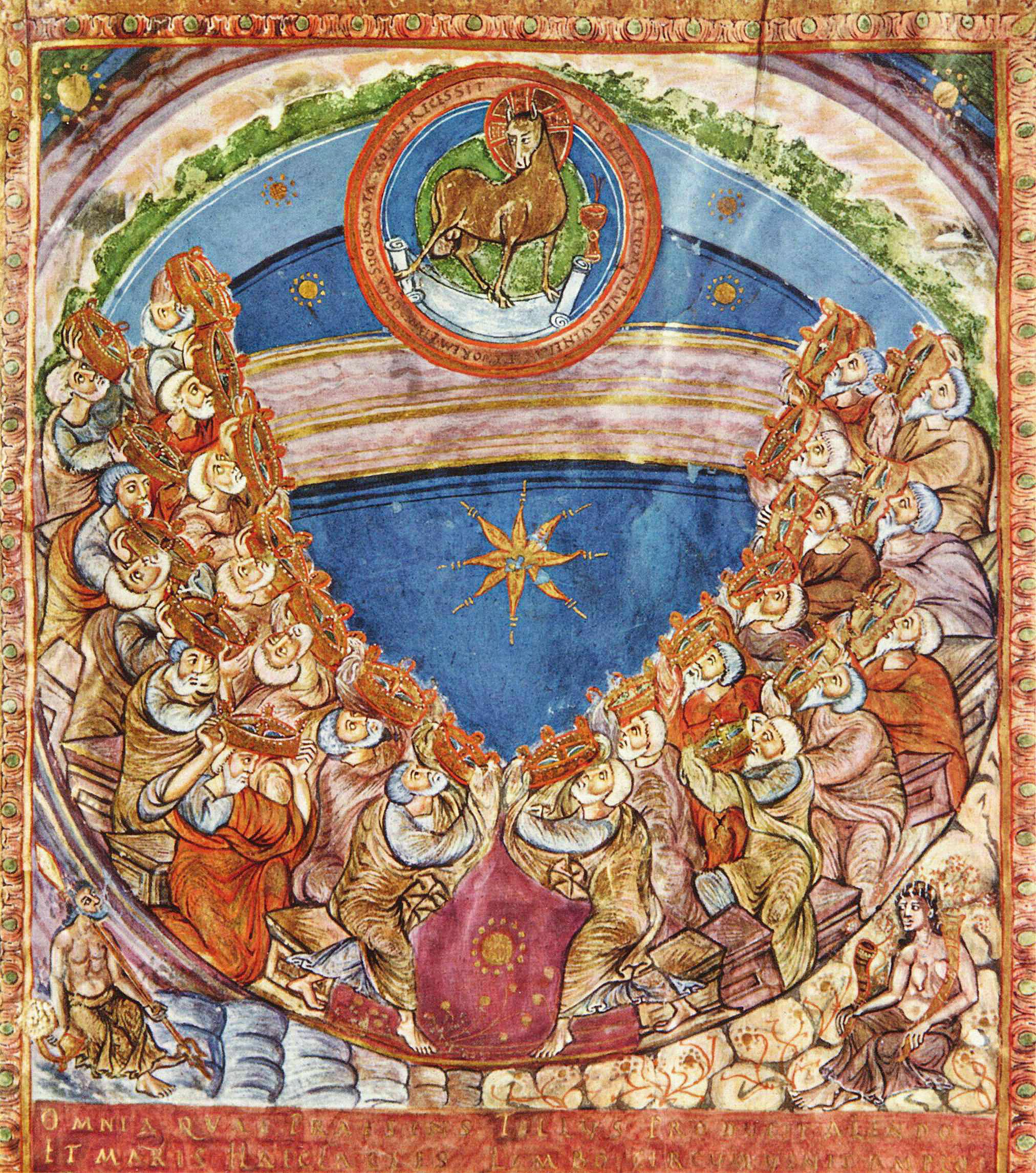
The Ophanim — Hebrew 'ōphannîm, 'wheels' — first appear in Ezekiel 1:15–21, immediately after the description of the four living creatures: 'Now as I beheld the living creatures, behold one wheel upon the earth by the living creatures, with his four faces. The appearance of the wheels and their work was like unto the colour of a beryl: and they four had one likeness: and their appearance and their work was as it were a wheel in the middle of a wheel.'
The description is precise and strange. Each living creature has a wheel beside it. The wheels move whenever the living creatures move; they stop when the creatures stop. The wheels do not turn as they go; they move in any direction without rotating their axis. Their rims are 'high and dreadful' — and the most striking detail — 'their rings were full of eyes round about them four.' These are perceiving wheels: the surface of the wheel is studded with eyes that see in every direction simultaneously.
Ezekiel 10:9–17 returns to the wheels in the second appearance of the throne-chariot, naming them as 'wheel' ('ōphan) and as 'the wheel' (collective). The connection between the wheels and the Cherubim is so intimate that the text frequently treats them as a single composite throne-vehicle: 'And when the cherubims went, the wheels went by them: and when the cherubims lifted up their wings to mount up from the earth, the same wheels also turned not from beside them.' The Cherubim provide the wings of the throne-chariot; the Ophanim provide its motion.
Daniel 7:9 echoes the same vision in a different setting: 'I beheld till the thrones were cast down, and the Ancient of days did sit, whose garment was white as snow, and the hair of his head like the pure wool: his throne was like the fiery flame, and his wheels as burning fire.' The 'wheels' here are the same Ezekielian Ophanim, transposed into the apocalyptic vision of the Son of Man's enthronement. The chariot-throne with its perceiving fiery wheels is one of the most consistent images in Hebrew apocalyptic literature, running from Ezekiel through Daniel into 1 Enoch (the chariot-throne in the Book of Parables, chapters 39–71) and into the rabbinic mystical tradition of merkavah (chariot) mysticism.
Pseudo-Dionysius the Areopagite, in Celestial Hierarchy VII, identifies the Ophanim with the Thrones — the third order of the first triad of the celestial hierarchy, ranked immediately below the Cherubim and Seraphim. His etymology of 'Thrones' (Greek thronoi) emphasizes their function: they are the seats — or rather, the bearers — of the divine presence. 'They are uplifted to a really transcendent contemplation of God,' he writes, 'undisturbed and devoid of all base inclination, dwelling and abiding in lofty regions, and rejoicing always in the divine indwelling.'
The patristic tradition therefore established a clear hierarchy among the highest three orders. The Seraphim burn perpetually in love. The Cherubim contemplate and transmit divine wisdom. The Thrones bear the divine presence in their eyed and burning motion. Together they form the first triad of the angelic ranks, the orders that turn entirely toward God and never descend in mission to the world below — that work belongs to the lower orders, especially the Archangels and Angels at the bottom of the hierarchy who interface with creation.
The Ophanim's wheel-form influenced later Christian art's depictions of the throne of God. The famous miniature of God enthroned in the Codex Aureus of St. Emmeram (c. 870 AD) shows the Almighty seated on wheels of fire surrounded by the four living creatures — an iconographic synthesis of Ezekiel and Daniel that became standard for Carolingian and Ottonian throne imagery. The same composition reappears in the Bible of Charles the Bald, the Vivian Bible, and through the medieval tradition into the great theological visualizations of the Romanesque and early Gothic period.